
Generic selectors
Exact matches only
Search in title
Search in content
Post Type Selectors
page
crb_teammbember
The Killers
Brandon Flowers on the origin of The Killers

The Killers

On a small stage at Sasha’s, a transgender bar off the Las Vegas Strip on a one-way street nicknamed the Fruit Loop for all the LGBT-friendly venues, a young, four-man band in thrift-store shirts and skinny ties honed their version of their signature song, the bright, needling guitar line contrasting with a lyric about jealous obsession. Ironically, Brandon Flowers had recently met his wife-to-be at a thrift store while buying clothes for the band’s very first gig at a coffee shop called Cafe Espresso Roma, but “Mr. Brightside” was already there.

Flowers would later talk about how the convictions he gained from his faith and family helped him avoid the vices and pitfalls often associated with rock culture. Such confidence gave support to the hustle of playing rooms like Sasha’s where the Las Vegas temperatures would sometimes climb to 100° F and where Flowers and his bandmates were hoping for a break.

Flowers had been let go from his first band, Blush Response, when he refused to move with them to Los Angeles. Guitarist Dave Keuning had also been out of work, having been let go from the Banana Republic following the 9/11 tourism downturn. Keuning placed an ad in the Las Vegas Weekly: “Seeking musicians for all original band. Influences: Oasis, Smashing Pumpkins, Bowie, Radiohead.” Flowers, newly determined to front a band after seeing Oasis perform at the Hard Rock Hotel, answered. He and Keuning hit it off. The band name came from the music video for New Order’s “Crystal,” where a fictional band had a bass drum emblazoned with the name “The Killers.” Flowers and Keuning took the name as an homage.

The very first song on the first cassette Keuning shared was a riff Flowers vibed with. Keuning found the opening guitar figure while playing in a clothes-stuffed closet, the only place in his apartment he could turn his amp up without bringing the neighbors to the door. Flowers added lyrics about his emotional response to a faithless ex-partner and the resulting song became “Mr. Brightside.” But when the group’s first studio session arrived, Flowers hadn’t yet finished the song. He didn’t have a second verse so he simply repeated the first one – a single long sentence that packs in a full imagined narrative about what a shocked lover is certain must be happening behind closed doors – a short-circuit that mirrors the song’s portrayal of jealous obsession.

Their shows, at first, were not glamorous. Their earliest promoter, Ryan Pardey, ran a coffee shop called Cafe Espresso Roma and booked bands there on the side. Pardey gave Flowers and Keuning one of their first chances to perform under The Killers name. The unremarkable debut was a short set in front of people more interested in coffee and newspapers than in an unknown guitar band.

In late 2001 and early 2002, the band, initially a trio of Flowers, Keuning, and drummer Matt Norcross, soon joined by bassist Dell Neal, booked time at the Kill the Messenger Studio in Henderson. Across those first sessions they put down early versions of “Mr. Brightside,” “Desperate,” “Under the Gun” and “Replaceable,” burning CDRs to hand out at gigs. Norcross would not stay long, but that session fixed an early version of the band on tape and gave them something to pass around.

Pardey also DJed and promoted nights at Sasha’s. When he started booking The Killers there, the same songs that failed to gain attention at Roma started to make sense in a hot, crowded bar steeped in the same British guitar-pop, post-punk universe the band was drawing from. Mark Stoermer, a local guitarist working as a medical courier and already a fan of the band, began turning up at shows and soon agreed to step in on bass to replace the departing Dell Neal while Ronnie Vannucci Jr., a UNLV percussion major and wedding-chapel photographer, took over on drums after the band let Matt Norcross go. By the time the band settled into regular slots, the classic lineup was in place. They rehearsed in Vannucci’s garage or slipped into the UNLV music building after hours, using the percussion rooms as an unofficial practice space.
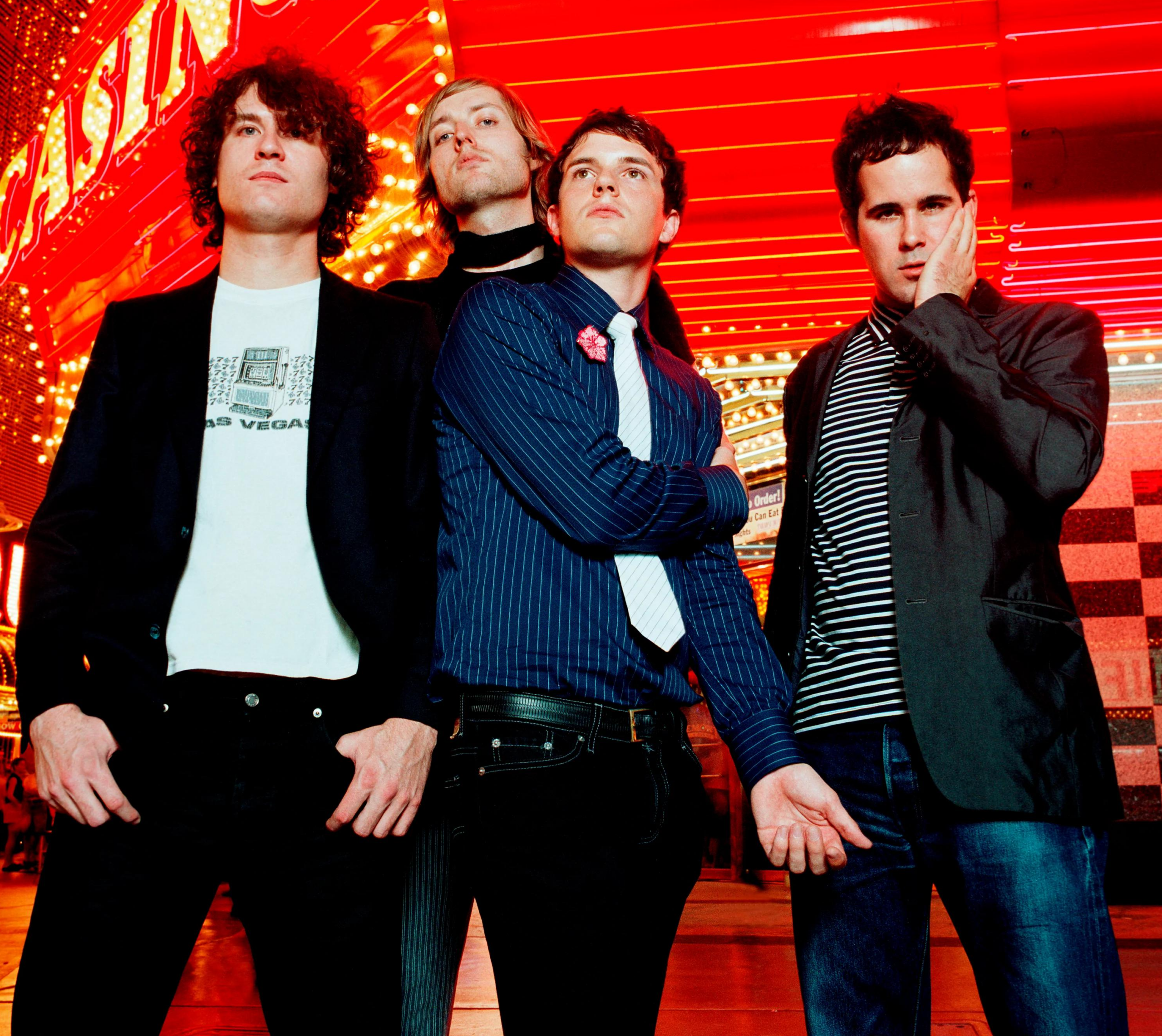
The band’s break came in the form of a young Warner Bros. talent scout, Braden Merrick. He found the band the way many people did in those years: clicking through a local-scene music website and expecting very little. Instead, he heard the Kill the Messenger version of “Mr. Brightside.” The tempo wobbled (Merrick actually mistook Norcross’s drumming for a bad drum machine) and the vocal wasn’t perfect, but he hear something promising. Merrick flew to Vegas, took the group to dinner, and eventually became their manager.

American labels still passed, but a Warner colleague named Alex Gilbert took the demos back to London and played them for his friend Ben Durling, who was starting an independent label, Lizard King Records, aimed at exactly this kind of transatlantic guitar band. On the strength of the recordings alone, before anyone at the label had ever seen the Killers onstage, Lizard King offered them a deal, and the band soon flew to England.

On 29 September 2003, Lizard King released “Mr. Brightside” as The Killers’ debut UK single. The limited pressing sold out in a week. The band that had been sweating through 100-degree nights at Sasha’s was finally coming out of their cage, fueled by a singular faith, to launch a track that would eventually become the most enduring song in British chart history and bring The Killers from their first coffee shop gig to the greatest stages on Earth.

How “Mr. Brightside” became a late-blooming phenomenon

Keuning had already sketched the musical core of “Mr. Brightside” in a cramped, clothes-stuffed closet, when Brandon Flowers responded to his ad. Keuning had been playing around with a guitar figure – those first memorable notes – moving one finger at a time until the pattern felt right. Flowers took Keuning’s four-track cassette home and came back with lyrics. When he returned, the song locked into place almost at once. Both have described a sense that something unusual had happened and that they had written something big.

The lyrics to “Mr. Brightside” came from a real night at the Crown & Anchor, a British-style pub off the Las Vegas Strip, Flowers said. He had a suspicion something was wrong, went to the bar, and saw his then-girlfriend with another man. The song’s single verse is basically that scene, plus an added imagined narrative, replayed in his head.

In November 2001 they scraped together about $2,500 and booked time at Kill the Messenger Studio in nearby Henderson, Nevada, where they cut a four-song demo, including “Mr. Brightside,” in a single, tense burst. The pressure shows up in the structure of the song itself. Flowers has said that he simply ran out of lyrics for a second verse while on the clock in the vocal booth. Instead of improvising he repeated the first verse exactly. That practical decision, born of nerves and procrastination, ended up defining “Mr. Brightside” narrative as a single obsessive loop.

CDr copies of the Kill the Messenger demo were handed out in 2002 in the tiny Vegas venues the band played. In a local indie music scene then dominated by nu-metal, punk and rap, The Killers’ hybrid of New Wave-leaning guitar pop and big choruses stood out.

When the rough studio recordings eventually reached Merrick, the Warner Bros talent scout, he went to see them live and soon became their de facto manager. Merrick took them to Berkeley, California, to work with producer Jeff Saltzman, former manager of Green Day, at a small studio called The Hearse. Neal left for personal reasons and Norcross was let go. The new lineup with Mark Stoermer and Ronnie Vannucci Jr. joining cut a more polished five-song demo.

Most American labels still passed, but a UK-based associate connected to Warner took that five-song demo back to London and played it for Ben Durling the founder of a startup independent label, Lizard King Records. Lizard King signed The Killers without ever having seen them onstage, purely on the strength of those recordings. The band signed with Lizard King in July 2003.

“Mr. Brightside” led the way. On August 19, 2003, it premiered on Zane Lowe’s BBC Radio 1 show, immediately positioning the Vegas band as part of a renewed, UK-facing rock moment. Six weeks later, on September 29, 2003, Lizard King released “Mr. Brightside” as The Killers’ debut UK single in a limited run of CDs and 7-inch records.

Pressing numbers for the first UK single are debated, most place the count at a mere 500 7″ records plus additional CD singles. The record paired “Mr. Brightside” with an early version of “Smile Like You Mean It” and helped establish the Killers’ early template for the sharp, Britpop-inflected guitar lines, synth undercurrents, and choruses that could animate festivals and arenas.

The single became a cult favorite on BBC Radio 1 and among staffers at XFM, and MTV2, which quickly put the video into heavy rotation after its April 2004 re-push. The song refused to fade. Even Island Records, who quickly signed the band after the Lizard King release, discovered that the original Saltzman engineered product was perfect. After signing the band, Island had asked them to re-record “Mr. Brightside” in a high-end studio using top-of-the-line equipment, but the resulting product lacked the urgent squall and grit of Saltzman’s version and the new recording was dumped.

The song peaked at No. 10 in both the UK and US, one of hundreds of songs that create the audio environment of an era’s nostalgia, but years after “Mr. Brightside” dropped something strange started to happen. In the 2010s, streaming algorithms in the UK started pulling the song into ’00s nostalgia playlists. The song – a catchy, angsty bop for all moods with an instantly recognizable opening riff,  driving rhythm, memorable lyrics, a shoutable chorus – started to become a staple sing-along at UK venues and college orientations. The song became a cross-generational bridge between Millennials and Gen Z, a “Sweet Caroline” for a new era.  Memes showing dead crowds at British pubs hearing the opening “Mr. Brightside” riff and going bonkers started going viral. Videos show British music festival-goers singing the song in unison even when the band isn’t playing.

The song’s cultural impact crossed the Atlantic in the 2020s, with American football teams adopting the song as a sing-along tradition at their home games. Sound engineers at the University of Michigan’s stadium cut the sound abruptly during the chorus so the more than 100,000 fans can continue the song a capella at a loudness that can shake the stands. Players for Buffalo’s professional team, the Bills, requested the song be played at their games, as well, the tradition continuing to spread.

The single has now spent more weeks in the U.K.’s Top 100 than any other track in history. it will surely break the 500 week mark in Spring 2026, and it is not slowing down. What began in a cramped Las Vegas closet has evolved into a global phenomenon that defies the typical laws of pop music shelf life. “Mr. Brightside” is now a permanent communal ritual.

by Sean Ransom – Dec. 18, 2025