
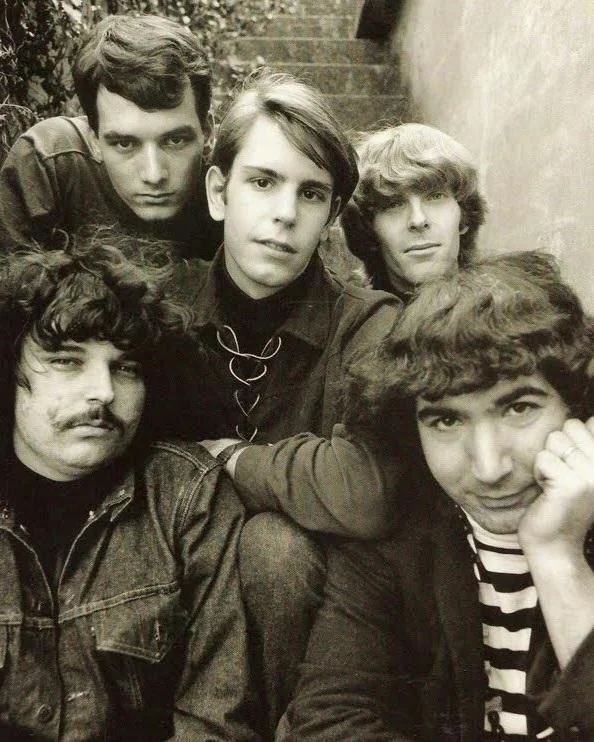
Grateful Dead
On New Year’s Eve 1963, 16-year-old Bob Weir and a couple of friends had come to downtown Palo Alto, Calif., where they heard banjo music coming from behind the door of Dana Morgan’s Music Store. Jerry Garcia, 22 years old, answered the door. Bearded and already a local fixture on the Peninsula folk circuit, Garcia taught guitar at Dana Morgan’s, played bluegrass and old-time music in every coffeehouse that would have him, and treated the store after hours as a kind of unofficial clubhouse. Weir and his friends grabbed some instruments and the chemistry took mere minutes to spark. By the end of the evening Garcia and Weir decided to start a old-timey jug band. Joined by Ron “Pigpen” McKernan, a blues-obsessed bartender’s son with a raspy voice, they played as Mother McCree’s Uptown Jug Champions, working up versions of Gus Cannon tunes, jug-band standards, and dusty country blues. They rehearsed in living rooms and back rooms, then graduated to the Top of the Tangent, a small room above the Tangent coffeehouse in downtown Palo Alto.
Palo Alto a the time was a knot of folkies, students, and proto–hippies orbiting the gravity of Stanford University. The scene featured coffeehouses like the Tangent, bookstores, guitar shops, and cheap rental housing, a micro-scene where Mother McCree’s fit easily. Garcia liked the looseness of jug band music. It let him bend country, blues, and old-time songs without worrying about perfection. Pigpen carried the blues authority. Weir filled in the spaces.
By mid-1965, however, the jug band morphed into an electric group almost by necessity. Garcia and company wanted to be heard in their venues. Pigpen, the son of a Bay Area R&B DJ, pushed the repertoire toward Lightnin’ Hopkins and Jimmy Reed, bringing a rougher electric sensibility. They raided Dana Morgan’s for gear, recruiting Bill Kreutzmann, a young drummer who’d been playing surf and R&B, and briefly using bassist Dana Morgan Jr. before asking their friend Phil Lesh, a trumpet player with avant-garde leanings and no bass experience, to learn the instrument. They called the new band the Warlocks. The gigs were small and local. By 1965 they were regulars at Magoo’s Pizza Parlor in downtown Palo Alto. They played dives, gymnasiums and a few events around San Jose. The Warlocks played electric versions of “Stealin’,” “Don’t Ease Me In,” “Viola Lee Blues,” and British-invasion covers. Tape from that period is scarce, but eyewitness accounts point to a band that was still ragged, sometimes under-rehearsed, yet already willing to stretch songs past the three-minute mark.
What they didn’t yet have was a context that matched the sound gathering around them. That arrived via Ken Kesey and the Merry Pranksters. Kesey’s Acid Tests, roving, semi-legendary parties organized around the then-legal LSD he and Owsley Stanley were distributing. The parties needed live music that could ride the drug’s unpredictable waves. The Warlocks found themselves at one of these happenings, surrounded by strobing lights, film loops, and vats of electric Kool-Aid. The Pranksters wanted a band that could jam without a setlist; the Warlocks wanted an audience that didn’t mind when songs dissolved into noise. It was a fit. The consensus inside the band was that they were a live unit, best experienced in a room with speakers shaking and lights spinning, but despite this there was a growing sense that they should get something, anything, on vinyl.
Eventually an up-and-coming New York City band named the Warlocks started making waves. Faced with changing their name, Garcia flipped through a dictionary of folklore and came across a phrase: “grateful dead,” a old narrative motif about a traveler who helps a forsaken corpse and later receives aid in return. The words felt right: odd, slightly ominous, but with a built-in story of debt and redemption. The Warlocks moniker was discarded for the Grateful Dead. (Ironically, the other Warlocks would also change their name, to the Velvet Underground.)
In the fall of 1965, they cut a rough demo at Golden State Recorders in San Francisco under the name “The Emergency Crew” for Autumn Records but that label’s financial problems and changing tastes kept it from turning into a proper deal. Still, there was a growing sense that they should get something—anything—on vinyl. The band had moved up the to San Francisco, and the Haight-Ashbury neighborhood was beginning to sprout small labels and private studios, often run by musicians or technically inclined bohemians. One of them, Gene Estribou, had a home studio in his house above Buena Vista Park in San Francisco. Estribou had already released his own music on a tiny label called Scorpio; now he was in a position to help the Dead make a first, local record.
In the early summer of 1966 the band hauled their gear up to Estribou’s place, the youngest band member, Weir, still a teenager at the time. Accounts differ on the exact logistics, whether the basic tracks were done entirely in that attic-like space or whether another commercial room was also used, but the result was a two-song single for Scorpio: “Don’t Ease Me In” backed with “Stealin’,” catalog number 201. Both songs came out of the band’s jug-band and folk-blues inheritance. “Don’t Ease Me In,” a traditional East Texas tune that Garcia had picked up from old field recordings, is taken at a brisk, almost clipped tempo, with Garcia’s vocal riding on top of chugging guitars and Pigpen’s organ stabs. “Stealin’,” drawn from a jug-band number associated with Memphis Jug Band, leans into a shuffling groove and a sly, almost conversational delivery.
The Dead’s first record has the feel of a working bar band. Tempos push and pull slightly, the guitars fuzz around the edges, but there is a clear attempt to get concise, radio-length takes down on tape. At around two minutes each, these are not the sprawling versions that would later surface on live tapes.
The initial pressing of Scorpio 201 was tiny, one reputable auction catalogue putting the run at about 250, and distribution was essentially hand-to-hand. Copies turned up at the Psychedelic Shop on Haight Street and in the hands of friends and early fans; there is no evidence of a coordinated promotional push. To complicate things further, legal and managerial issues reportedly led to the single being recalled not long after it appeared, ensuring that even locals could easily miss it.
The band took up residence at 710 Ashbury Street in the Haight, a Victorian house turned communal crash pad that became as much a symbol as an address. They played the Trips Festival, the Fillmore Auditorium for Bill Graham, and the Avalon Ballroom for the Family Dog, sharing bills with Jefferson Airplane, Big Brother and the Holding Company, and Quicksilver Messenger Service. The sets were longer now, and songs such as “Viola Lee Blues,” “Caution (Do Not Stop on Tracks),” both reworked jug-band numbers, became launch pads for long, modal excursions. The same band that had once struggled to be heard over a pizza-parlor crowd was now one of the loudest, freest acts in a rapidly coalescing psychedelic-rock circuit.
Within a year of the Scorpio misfire, the group would sign with Warner Bros. Records and record their self-titled debut LP in Los Angeles and San Francisco studios, adding “Stealin’” and “Don’t Ease Me In” to a longer list of possibilities before ultimately releasing a different set of songs. The Scorpio release was nearly lost, scarce copies remaining in the hands of a few people close to the band or associated with the label. But as the Dead’s reputation grew, that small, nearly-lost red-label 45 serves as a marker of the beginning of a band that became legend.
by Sean Ransom – February 16, 2026