
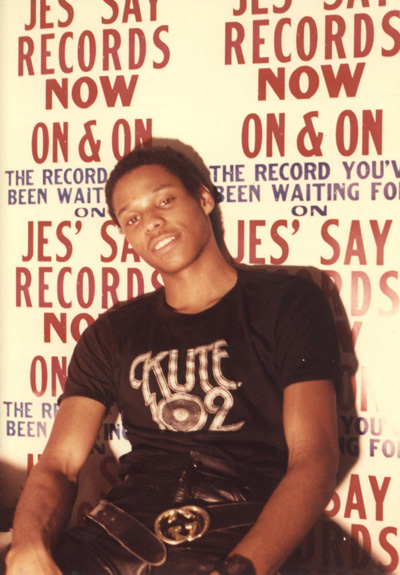
Jesse Saunders
On weekend nights on Chicago’s South Side in the early 1980s, the line outside the Playground wrapped around the block, teenagers waiting to get inside a former roller rink that had been turned into a high-school disco. When the fog machines started and the doors opened, the skinny young DJ named Jesse Saunders was at the center of it all, mixing records with such an unbroken glide that the crowd could dance for twenty minutes without a seam.
Saunders stood behind three Technics turntables, a reel-to-reel deck, and a drum machine. He built extended “pause mixes” and medleys from the crates of disco, Italo, electro and R&B 12-inches stacked behind him. The Hot Mix 5 ruled the airwaves; Frankie Knuckles was reshaping disco a few miles away at the Warehouse. But the teens at the Playground weren’t getting into the Warehouse yet. For them, Saunders was the reference point.
Born in Chicago in 1962, Saunders grew up in a family where records were everywhere; an older relative ran a record shop, and by his early teens he was already the kid who knew which imports had the best drum breaks. In high school he gravitated toward another young DJ, Wayne Williams, who would form the influential Chosen Few DJ collective. Watching Williams work, Saunders began to think not just like a fan but like an operator: which records filled the floor, which ones thinned it, how long a crowd would ride a groove before needing a twist.
By the early 1980s, disco’s wave had crashed, but its afterlife was thriving in Chicago’s black clubs and on radio. The Warehouse, the Music Box, the Power Plant, and the Playground each had its own take on a post-disco sound. DJs at these clubs folded in European synth-pop, Philly soul, dub effects, and drum machines, which were just starting to create their own impact on the sound. For Saunders challenge was keeping dancers locked in motion and playing something no one else could play. Many of the records Saunders relied on were imports or limited-press U.S. releases that only a few shops carried. One of them, a 12-inch medley B-side called “On & On” by the mysterious act Mach, was particularly powerful. Built as an extended disco megamix, Mach’s track stitched together bass and synth figures from Player One’s “Space Invaders,” Donna Summer’s “Bad Girls,” Lipps Inc.’s “Funkytown,” and other fragments into a hypnotic, looping groove. Saunders started using it as his personal theme, dropping it at the beginning of sets at the Playground and other gigs.
Then he was robbed.
One night in 1983, as Saunders later told it, a batch of his most prized records vanished from the Playground’s booth. Mach’s “On & On” was among them, and with it went Saunders’s signature sound. There was no guarantee he could find another copy of the obscure import. Losing “On & On” meant losing a key part of how he handled the room.
In an obsessive act of invention, Saunders decided to rebuild the record himself, making it his own, and in doing so he launched a world-shaping new genre of music that has reverberated well into the 21st century.
In his bedroom at 7234 South King Drive on the South Side, Saunders set up a Tascam four-track cassette recorder and a Roland TR-808 drum machine. Instead of re-clearing samples from half a dozen disco records, he and his friend Vince Lawrence, a young songwriter and DJ who’d been promoting events like the Playground parties, set out to capture the feel of Mach’s medley with all new parts. Lawrence wrote a simple, chant-like vocal hook and verses about the experience of dancing all night. Saunders programmed his own drum patterns and synth lines that echoed the “Space Invaders” bass motif without copying it outright. Where Mach’s version was a medley of other artists’ work, the new “On & On” would be an original composition built expressly for the club.
The result was a stark and functional drum-machine groove, a looping bass line, spare keyboard stabs, and hypnotic club vocals. It was, crucially, designed from the ground up for the kind of continuous mixing Saunders did at the Playground. The arrangement left long stretches of beat and bass for DJs to ride, with the vocal and synth figures dropping in. The invention was intended to be a DJ’s tool for the club rather than a radio-favorite.
To get it out of his bedroom and onto turntables, Saunders and Lawrence decided to press the track themselves. They created a new imprint, Jes Say Records, and scraped together money to cut a 12-inch single, “On & On” backed with another track, “Fantasy.” Most sources put the first run at about 500 copies, others higher, but everyone agrees it was tiny by major-label standards. They took the finished records to local shops like Importes Etc. and Loop Records, and handed copies to radio DJs on stations that catered to club music.
The response was immediate. The same kids who had once packed the floor when Saunders played Mach’s bootleg now responded even more intensely to the home-grown “On & On.” Local radio mixed it into specialist shows. Other DJs, hearing a Chicago-made record built specifically for the way they played, began asking when they could get their own copies. The first pressing sold through; more were ordered. In club after club, the Saunders/Lawrence “On & On” slipped into sets alongside Eurodisco imports and Salsoul 12-inches, but its architecture was subtly different. Where disco records often swelled toward choruses and breakdowns, “On & On” seemed to hover in a locked-in state, engineered for the new aesthetic of long-form mixing and drum-machine manipulation. This difference launched the record into history. Many strands fed into what would be called house music: Frankie Knuckles’ epic re-edits at the Warehouse, Ron Hardy’s anything-goes experiments at the Music Box, Jamie Principle’s “Your Love,” Chip E’s “Like This” and “Time to Jack,” and dozens of other early Chicago tracks. But “On & On,” released on Jes Say in 1984, is widely credited as the first commercially pressed house music 12-inch, manufactured and sold as a new kind of dance music made by and for the Chicago dance scene.
Saunders himself has leaned into that framing, often billed as “The Originator” of house music. If you have to point to one piece of vinyl and say “this is where house starts,” you point to “On & On.”
For Saunders the significance at the time was more practical. Making his own record solved a problem: it replaced a stolen tool in his DJ arsenal with something he controlled. It also opened a door. “On & On” proved that a local DJ could translate the energy of a Chicago dance floor into a product that could circulate beyond any one room. In the wake of Jes Say JS-001, other DJs and producers followed, Steve “Silk” Hurley, Marshall Jefferson, Farley “Jackmaster” Funk, Larry Heard, each bringing their own variations to a rapidly forming Chicago genre.
The teenager DJ at the Playground now found himself at the front edge of a movement. The Playground kids grew up and the sound they’d helped incubate traveled far beyond them. Within a few years, imported Chicago house 12-inches were reshaping club culture in London and Manchester; by the end of the decade, house’s descendants – acid, deep house, techno – were global.
Standing at the booth in the former roller rink on Chicago’s South Side, Saunders couldn’t have known any of that. He was trying to fix a set that no longer felt right without a particular record. The solution: a drum machine, a four-track, a friend who could write a hook, and the decision to press their own 12-inch, turned that small, local problem into a hinge point in dance-music history. “On & On” was, in one sense, just another tool for a working DJ. In another, it was the moment when the sound of Chicago’s club underground stepped onto its own piece of vinyl, ready to travel.
by Sean Ransom – February 18, 2026