
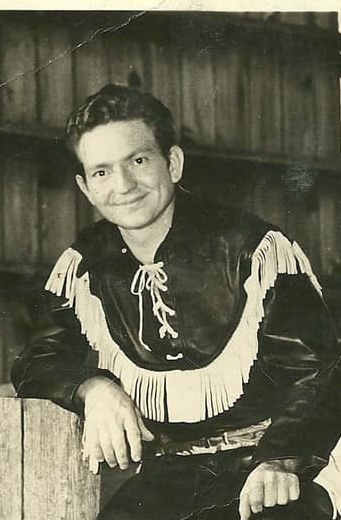
Willie Nelson
Willie Nelson’s musical beginnings start with his childhood town of Abbott, Texas. Raised with his sister Bobbie by their paternal grandparents after his parents separated, Nelson moved between the blacksmith shop where his grandfather worked and the church where the family sang, His grandparents gave him a guitar, Bobbie was given a piano. Music lessons helped structure the fractured family.
The musical culture around Abbott supplied the rest. In the 1930s and 1940s, during Nelson’s growing up years, Abbott was a small North Central Texas town shaped by railroad decline, farm and church life, and a melange of musical inheritances. The music of the Czech and German immigrants that populated the region remained audible in the surrounding communities, as did country radio, western swing, hymn singing, dance music, and the repertoires of local working bands. Nelson’s early musical world is often summarized simply as Texas country gospel but he was in reality steeped in a more local and more diverse environment where musical styles merged and existed alongside one another in a way unique to the American melting pot.
Nelson was both submerged in and a part of this musical miscellanea, performing by age ten in a central Texas polka band. School appearances, local dances, and honky-tonks gave a first rough education in the musical room. The Grand Ole Opry had already been exerting its cultural gravity on the American South and stars like Ernest Tubb, and Bob Wills stayed with him. Nelson heard sacred music and secular music, fiddle tunes and dance tunes, country songs and polka rhythms, and took from them all, plus a habit of work that put it all together. The later looseness of Nelson’s phrasing, his elastic timing, even the sense that he belonged to country music while standing slightly apart from it all of that begins here, in a childhood filled with practical music.
While still in high school he and Bobbie played with Bud Fletcher and the Texans, but fame and fortune had to wait. He served briefly in the Air Force, married Martha Matthews, had children and started to face the demands of adulthood. Writing was one thing could be used to pay bills. Playing paid something. So did working radio. Radio kept Nelson closer to a life in music, albeit still on the periphery. Between club dates, station work, side income, unstable footing, a growing family, the accumulation of songs he had penned had almost been a byproduct of pressure. In later years he would speak casually about this early poverty as a reliable engine for songwriting. He lived this truth deeply.
Nelson’s later public image is so bound to Texas that Vancouver, Wash., can look like a side gig. In the mid-1950s KVAN radio offered the then-clean-shaven 23-year-old a program and he moved the family there, working as a disc jockey under the name “Wee Willie Nelson,” and hosting his program The Western Express. He introduced himself every day as the “cotton-pickin’, snuff-dippin’, tobacco-chewin’, stump-jumpin’, gravy-soppin’, coffee-pot-dodgin’, dumpling-eatin’, frog-giggin’ hillbilly from Hill County, Texas,” and played live in Portland-area clubs at night. Radio paid a wage but also gave him the more valuable side benefits of a microphone, a listening audience, a local identity, and, eventually, a platform for his own first self-released record.
Nelson’s hardscrabble upbringing gives context to this first micro-pressed release, a 45 rpm single with his own “No Place for Me” as the lead and his version of “Lumberjack,” a song by fellow KVAN DJ Leon Payne, on the B-side. Recorded in the KVAN radio studio and issued on the near-fictitious label Willie Nelson Records, “No Place for Me” was made with the stripped-down, poor-man’s practicality that defined so much of his early life. Nelson, backed by Buddy Fite on steel guitar, is listed as as singer, guitarist and recording engineer. He sent his tapes to a custom record pressing company, Starday, for an initial 500 copies, which he sold on the air, and ended up moving, according to best estimates, about 3,000 of these disks over time, which he mailed to listeners of his radio show. This independent streak would later be romanticized as an outlaw temperament but it was mostly practicality, self-reliance and an unconquerable desire to create something of himself and his music.
As a piece of music, “No Place for Me” is modest and revealing. It is brief, plainspoken, unadorned, lacking the full Willie Nelson voice that would later make him a legend, but the record does show his capacity for direct feeling, his aversion to fuss, and a preference for economy over show. Although the song would later reappear in various Nelson retrospective compilations, the song didn’t make him a star.
As the record faded into relative obscurity, more prelude than breakthrough, he drafted back to Texas, playing around Houston. At the Esquire Ballroom, a prominent country venue, Nelson tried to sell bandleader Larry Butler a set of his songs for $10 apiece. Butler did not buy the songs. He did, however, loan Nelson $50 and put him in his house band six nights a week. Nelson moved his family to Pasadena, Texas, and his career got some traction, and soon his songwriting did too. The commercial industry didn’t have much use for Nelson’s vocal phrasing, rhythmic looseness, and lack of polish, but they liked his songs. His first songwriting hit, Claude Gray’s Top 10 rendition of “Family Bible,” gave Nelson credibility that took him to Nashville where he eventually launched into the stratosphere and almost broke country music with him. But that last bit is a story for another day.
“No Place for Me” is the earliest tangible snapshot of a man whose method was practical, hardscrabble persistence. There was no destiny in Willie Nelson’s debut, but for Nelson destiny and method were almost the same thing.
by Sean Ransom – March 26, 2026