
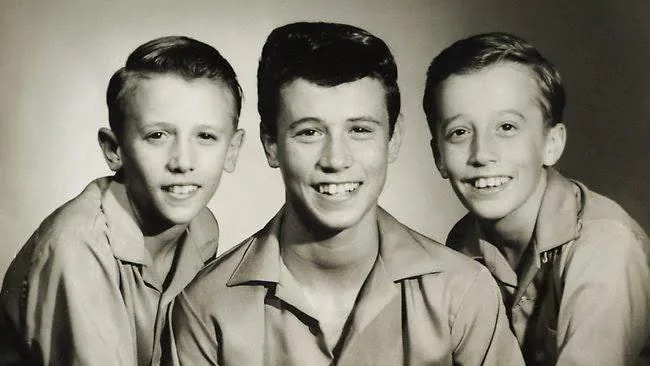
Bee Gees
A boiling teapot in a home on the Isle of Man in 1948 almost kept the world from some of the most iconic music in pop history. It was then that the nearly 2-year-old Barry Gibb, later the falsetto-voiced front man for the Bee Gees, the band who became the face of disco, stretched up to a table and knocked the boiling pot over to create a scalding wave that put his life in serious danger. Skin grafts didn’t exist, gangrene set in, and many feared that Barry was moments away from death.
Instead, Barry Gibb stayed alive.
Barry Alan Crompton Gibb was born in 1946 to Hugh Gibb, an itinerant drummer who played in hotels around the island, and homemaker Barbara Pass Gibb. The family bopped around the Isle, moving from house to house. Barry and his older sister were joined by younger fraternal twin brothers, Robin and Maurice, and later by another brother, Andy, whose career in music turned out more tragic, which is another story.
But Barry thrived. He was 11 when he founded his first band, the Rattlesnakes, in Manchester after his family moved there in 1955. He was joined by Robin and Maurice plus a couple of neighborhood friends and they eventually started scoring professional gigs with their popular covers. The brothers continued playing through multiple moves, including the big one – emigration to Australia in 1958. By this time the family had moved at least a half-dozen times in Barry’s short life. The passenger manifest on the ship that set sail to Australia, however, might have been a sign of things to come. It included Kylie Minogue’s parents and 9-year-old Red Symons, who would enter Australia’s recording artist hall of fame as a member of the Skyhooks.
The Gibbs family found a home north of Brisbane, where Barry, Robin and Maurice formed a band and continued to hustle. It was at the nearby Redcliffe Speedway that the three started to get professional attention. They would ride the back of a truck and play for fans between races, singing over the public address system and keeping the money that the fans would throw. The racetrack’s promoter, Bill Goode, introduced the three to Brisbane DJ Bill Gates. Gates invited the boys to record a couple of acetates that he played on his show, with callers suddenly asking to hear more. Bill Gates recalls in one of those early meetings, he and Bill Goode and met with the Gibb family and settled on the name, The BG’s, for the boys, since Bill Goode, Bill Gates, Barry Gibb, Barbara Gibb, and the Brothers Gibb, were all at the meeting. Plus, they correctly thought the name sounded cool.
Another move, this time for the brothers to seek out new recording opportunities, changed the boys’ trajectory yet again. Hugh gave up his work and started managing the boys, and despite being teenagers the Gibbs were by now experienced musicians. Barry had also been writing his own songs with prodigious talent, renowned for his ability to write a passable song in just five minutes. Backed by their father, who supported their ambitions, the family moved to Surfer’s Paradise and The Bee Gees played in resorts on the Gold Coast, their original songs catching interest of people in the Australian music industry. They landed a TV gig in the early days of Australian television, convinced an agent to hire them, and then opened for Chubby Checker at Sydney Stadium in 1962, when Barry was just 15 and the twins were 12. One of these connections was pioneering Aussie rocker Col Joye, the first Australian to hold a No. 1 pop record on the Australian charts years earlier. Joye promoted the Bee Gees to his label, Festival, and became essential in managing and publishing the group. Festival subsidiary, Leedon, signed the brothers in 1963.
The first record the Bee Gees released was “The Battle of the Blue and the Grey,” a Barry-penned, twangy country song from the perspective of a Confederate soldier who, under the command of Stonewall Jackson, filled a Union man full of lead. The incongruity of these young, English-Australian teens singing original ditty about the violent preservation of the Confederacy somehow didn’t dissuade Leedon from releasing it. The song got a little traction around Sydney, if only for the cringe-inducing novelty. However, this, and nearly all the other dozen or so Bee Gees records Leedon released, were considered flops. Leedon started to lose interest.
But the boys’ career in other ways continued to flourish. Through 1963 and 1964, the band played regularly on Australian TV, culminating with their own television special. The boys, and Leedon, had a minor hit single with “Wine and Women,” and put out their first LP, in 1965, an album with the possibly uninspired title The Bee Gees Sing and Play 14 Barry Gibb Songs. In addition, some of Barry’s songs started getting recorded by other, more established artists, including the song “They’ll Never Know,” by Wayne Newton. Nevertheless, by 1966 the boys’ recording career started to look stalled. Leedon wouldn’t release them from their contract but sublet them to other labels.
Spin Records didn’t have the same impatience for a hit. In the summer of 1966, Spin producer Ossie Byrne apprenticed the Gibbs brothers in his tiny music studio behind his butcher shop in the town of Hurstville, a Sydney suburb, and let the teenaged Bee Gees define their own sound. Byrne became the group’s new manager and shepherded the band’s first major success, “Spicks and Specks” for the Spin label. This was the success everyone had been looking for. Released in September 1966, “Spicks and Specks” was a hit throughout Australia. A full album was released, the Bee Gees were voted Australia’s Group of the Year and Barry got the country’s top songwriter award from the national press.
But by then the boys eyes were again elsewhere. They moved. This time back to the U.K. “You’ve got the only act here that will make it overseas,” Hugh Gibbs recalls Col Joye telling him. The hustle and the grind continued, but also the connections – the Bee Gees were soon picked up by the same management company who represented the Beatles and immediately were christened the “new Beatles.” International top-20 hits, “New York Mining Disaster 1941” and “To Love Somebody” (later covered by acts as diverse as Janis Joplin and Nina Simone) followed.
The Bee Gees’ debut story, at least as far as commercially available recordings goes, starts with the cringey “The Battle of the Blue and the Grey,” but it’s really the story of their childhood band The Rattlesnakes, the singing from the truck beds at the Redcliffe Speedway, and the summer of generous studio apprenticeship in the summer of 1966. Three impoverished boys from the Isle of Man, backed by a family and mentors who believed in their talent, worked for decades for a taste of success. These three brothers and those who helped them changed the face of music. The Bee Gees entered both the Rock and Roll Hall of Fame and each brother is in the Songwriters Hall of Fame as well, as befitting a band who changed music while becoming one of the best selling groups of all time.
by Sean Ransom – May 22, 2026