
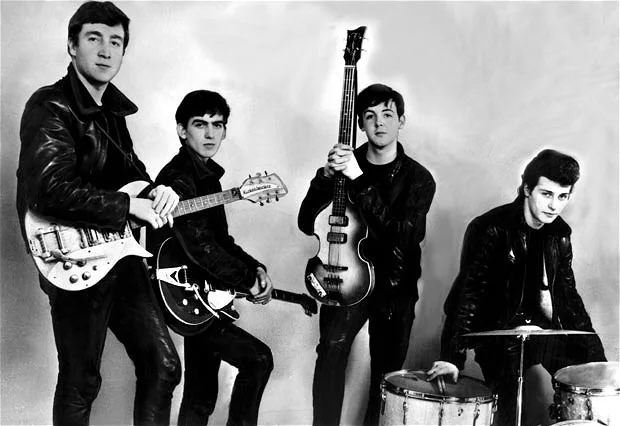
The Beatles
It was a hot and humid summer afternoon on July 6, 1957, when music received its most legendary songwriting duo of all time. Skiffle, a fusion of blues, jazz and folk with roots in the U.S. South, had been a craze in the English music scene, making it all the way to the working-class port city of Liverpool. There, sixteen-year-old John Lennon was setting up for a show at a church garden party with his band, the Quarrymen. His bass player approached and introduced him to a fifteen-year-old friend and classmate: Paul McCartney. McCartney tuned Lennon’s guitar and then played a few songs to demonstrate his skill. Lennon, impressed with the quality of McCartney’s playing, soon offered him a permanent spot in the band. Together, they performed at school halls, clubs, and amateur venues.
McCartney was overcome with nerves and struggled through the initial shows. He sounded so good during the first rehearsal that they gave him a guitar solo, but when the show began, he froze. “Things were going fine,” McCartney later said, “but when the moment came in the performance, I got sticky fingers; I thought, ‘What am I doing here?’ I was just too frightened. I couldn’t do it. That’s why George was brought in.”
That George was George Harrison, McCartney’s classmate at Liverpool Institute. Just fifteen years old, Harrison immediately became an indispensable member of the band, elevating the group’s musicianship with his notable technical skills and rock-and-roll flair. In the spring of 1958, the band, which at that time also included drummer Colin Hanton and Colin Duff Lowe on piano, landed their first recording session at the home of Percy Phillips, a local salesman who’d converted his Victorian living room into a rudimentary studio. For a small fee, musicians could record demos onto shellac or acetate disks. The Quarrymen paid 17 shillings and six pence for a single 10-inch acetate disk. On it were their cover of Buddy Holly’s “That’ll Be the Day” and an original called “In Spite of All the Danger,” written mostly by Paul McCartney. They had only one take and used only one microphone. The sound quality was abysmal, but it marked a major milestone: Lennon, McCartney, and Harrison’s first recording session together. Lowe kept the copy until 1981, when he sold it back to McCartney.
By 1959, the Quarrymen had moved away from their original skiffle sound and set their sights on rock and roll. They continued playing around Liverpool, changing their band’s name time and time again, until their manager, Allan Williams, sent them to Hamburg in 1960. He’d had success with another band in the German city and he could repeat the results. There, they played hundreds of shows, sometimes up to 8 hours per night. Hamburg forced them to expand their repertoire, build endurance, and strengthen their confidence as performers. In 1961, they caught the attention of Bert Kaempfert, who invited them to back singer Tony Sheridan in a professional studio session. In just two sessions, they recorded eight songs, the group’s first commercial recordings. Among them were “Ain’t She Sweet,” which featured Lennon on lead vocals, and “Cry for a Shadow,” an instrumental that would turn out to be the only Lennon/Harrison co-credit. Despite finally settling on the name “The Beatles” before leaving England – a punny homage to Buddy Holly and the Crickets – the group was called “Tony Sheridan and the Beat Brothers” during their Hamburg residency, a name Kaempfert liked. The very first commercial record released with young Beatles playing was a rousing, rock-and-roll single of the traditional Scottish folk song, “My Bonnie,” with the American spiritual “When the Saints (Go Marchin’ In)” on the B-side, released on Polydor records in December, 1961.
Back home in Liverpool, they’d gained a following at the Cavern Club, a low-ceilinged, brick venue beneath the old Liverpool rain shelter. Brian Epstein, a record-store manager, saw the group, now officially “the Beatles,” perform at the crowded, underground venue in late 1961 and instantly recognized their talent. Determined to see their commercial success, Epstein became their manager and sought recording contracts relentlessly. Finally, Parlophone, an EMI subsidiary operated by producer George Martin, agreed to an audition.
On June 6, they stepped into Abbey Road Studios for the very first time. A contract was already in the works. They underwent a “test session,” during which they recorded “Love Me Do,” “P.S. I Love You,” “Ask Me Why,” and “Besame Mucho”: four originals and a cover. Their faulty equipment produced nothing but a “load of noise,” as lead sound engineer Norman Smith put it. He struggled to retrieve any valuable content from the recording. The EMI staff was unimpressed. Producers typically didn’t attend artist tests, but eventually, George Martin himself showed up and took over the session. He lectured the group about the poor quality of their equipment and what he expected of them as studio musicians. They said nothing. Once he finished, Martin asked if there was anything they didn’t like. After a long and awkward silence, George Harrison finally remarked, “Yeah, I don’t like your tie!” Everyone erupted with laughter, and the mood in the room instantly changed.
The Beatles were improving rapidly, and they grew increasingly frustrated with their drummer, Pete Best. He couldn’t keep up with the rest of the band musically, so the other members asked Brian Epstein to fire him. They already had a replacement in mind: Liverpool legend Ringo Starr. Once Best was out of the picture, Starr took his spot as the fourth and final Beatle: the lineup was complete.
They recorded the songs again with Starr on drums and tambourine and released “Love Me Do” in October of 1962. “P.S. I Love You” was on the B side of the disc. These songs may not match the creative quality of their later work, but they showcased McCartney and Lennon’s dynamic songwriting collaboration, which would only improve with time. “Love Me Do” rose to #17 on the British charts, a modest but reassuring beginning. The Beatles returned to the studio on February 11, 1963, to record their first album, “Please Please Me,” in a single marathon. In just a day, they managed to complete ten songs. The album was released on March 22. By May, it had reached #1 on the British charts, and it remained there for thirty weeks until their second album, “With the Beatles,” took its place. “Please Please Me” was the first of many record-breaking triumphs. The Beatles were only just scratching the surface of their fame and international success.
by Libby Northup – June 22, 2026