
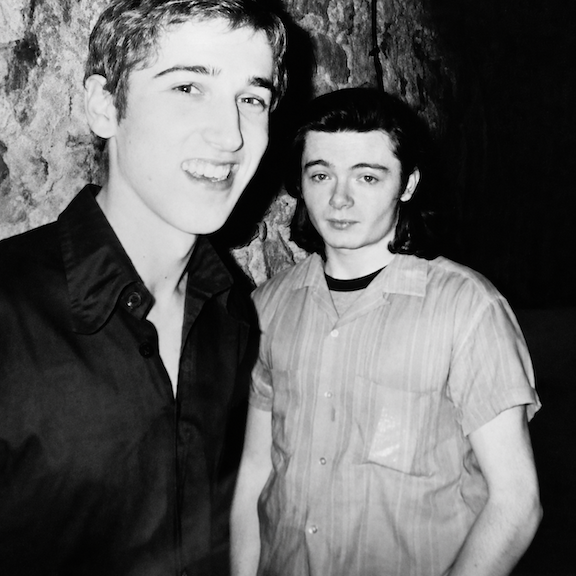
Daft Punk
Thomas Bangalter and Guy-Manuel de Homem Christo met when they were twelve years old. They attended Lycée Carnot together in Paris, 1987, and quickly bonded over rock and countercultural American cult films. To two kids in a prestigious Parisian high school, a film like Easy Rider showed them gritty, guitar-fueled soundtracks that they had never heard before. In their structured, upper-middle class French life. In the French mainstream, electronic pop suddenly felt lifeless and overly safe, and the two boys decided to make some rock music.
Thomas Bangalter grew up in an intensely musical household. His father, Daniel Vangarde, was a famous French disco producer and songwriter. From age six, Thomas was forced into strict, daily classical piano practice by his parents. Raw, 1960s and 70s rock, specifically The Velvet Underground, offered him an escape from the rigid discipline of classical training.
The two boys chose to form an indie rock band, and became a trio when Laurent Brancowitz found their band advertisement on a wall of the record store, Danceteria. They named themselves “Darlin’”after the Beach Boys song, and they ended up with Bangalter on bass, Homem-Christo on guitar, and Laurent Brancowitz on guitar and drums.
After creating a few songs in a small, lo-fi garage setup, and playing a few gigs in mid 1992, they sent demos over to Stereolab. Their mutual friend helped get their cassette into the hands of Stereolab frontwoman Lætitia Sadier. She was impressed by the group’s energy, but saw that they only had two songs. Ultimately, she signed them to Duophonic Records and Stereolab put two of Darlin’s songs onto an upcoming 7″ double pack compilation called “Shimmies in Super 8,” an EP featuring various noise-pop and indie artists. Darlin’ were signed in late 1992, exclusively for that single compilation release. It was a one-off agreement rather than a traditional, long-term record contract, but they were invited to open for some of their shows in the United Kingdom, which they played.
By the time the EP dropped their two songs, “Cindy So Loud” and “Darlin’,” in April of 1993, Bangalter and Homem-Christo got into the French rave scene.
The “Armistice” party on November 10, 1992, is widely considered the exact night Daft Punk was born. It was a monumental turning point, one that caused Thomas Bangalter and Guy-Manuel de Homem-Christo to completely abandon rock music. The rave was held on the roof of a Beaubourg museum called the Centre Pompidou: a famous, hyper-modern architectural landmark in Paris. The museum converted their top-floor rooftop into a massive rave dancefloor, an unprecedented act in the city’s early electronic scene. Bangalter and Homem-Christo recall how reaching the top gave them a bird’s-eye view of Paris at night, and they were surrounded by pulsing lights. The massive sound system could be heard floors below as they ascended the escalator and felt the bass rattle the walls. They joined a completely unified, energetic crowd, which was unlike anything they had experienced in the indie-rock circuit. Bangalter later explained, “At last we would discover, on a decent sound system, Chicago house and Detroit techno, the dance music which would change our lives.”
The second thing that would change their lives is a critique written by journalist Dave Jennings in the magazine Melody Maker. The issue appeared in the May 1, 1993, saying the two Darlin’ tracks are “daft punky thrash.” The band found the review amusing, and it inspired Bangalter and Homem-Christo to change the band’s name to “Daft Punk” as they rebranded their sound. Laurent Brancowitz stepped away from the band once they shifted to electronic music, because he wasn’t a fan of techno. Darlin’ only ever played a total of two live gigs before breaking up, and disbanded after around six months after having produced four songs. Brancowitz later created his own Grammy winning band, Phoenix.
Using electronic instruments purchased with money Bangalter received for his 18th birthday, the now-rebranded duo begin recording with drum machines and samplers in their bedrooms. Their first demo, called “The New Wave” was a seven-minute long techno track.
In September of 1993, their friend Serge Nicolas introduced them to Slam, a Scottish electronic music duo who also ran a moderately-sized record label in Glasgow called Soma Quality Recordings. Finding the label’s contact information on the back of a Slam record, Daft Punk initially sent a cold fax to Soma, letting them know they had recorded some music, but the actual signing happened in person.
In November 1993, Slam was booked to play a massive underground rave in a field located just outside the EuroDisney complex in Paris. The duo hung out with Slam for two days before handing them a cassette tape demo. Slam took the tape back to an apartment to listen, and despite the scratchy, raw audio quality of the cassette tape, the music was so impactful that Slam signed Daft Punk right then and there.
By November 10th, Daft Punk had completed their first EP, titled “The New Wave,” which consisted of three tracks plus a radio edit. It had both edit and full-length versions of “The New Wave,” “Assault,” and “Alive (New Wave Final Mix)”—the latter of which would eventually be reworked and featured on their legendary 1997 album, Homework.
“New Wave” was released in April of 1994. When it did finally release, it found moderate success. While it didn’t chart globally, the underground rave scene received it warmly and established their underground credibility as a promising new act. Club DJs began circulating and playing the tracks across the UK, France, and Italy. The aggressive, acid-house sound created a localized buzz that caused their record label, Soma Records, to have many more inquiries than they anticipated. It gave Daft Punk the momentum they needed.
As the years go on, they would be regarded as one of the most influential acts in electronic dance music. Daft Punk assumed robot personas for their rare public and media appearances, with helmets, outfits and gloves to disguise their identities. They would go on to win six grammys, create a #1 on Billboard’s Hot 100, and their final album Random Access Memories, would make Rolling Stone’s list of the 500 Greatest Albums of All Time in 2020.
The Centre Pompidou remained important to the duo even as more years went by and Daft Punk ended up moving on to solo projects separately. In October 2025, just before the Centre Pompidou closed for a massive five-year renovation, Thomas Bangalter made a surprise appearance to play his first public, unmasked DJ set in over 24 years. On the elevator ride, Bangalter turned to his friend and told him that the elevator ride was mirroring the exact moment he fell in love with electronic music in that very building back in 1992.
– by Kate Ransom, June 30, 2026