
Generic selectors
Exact matches only
Search in title
Search in content
Post Type Selectors

A Number of Names

OMMA Catalogue Number

OMMA-0103

Artist

A Number of Names (as ANUMBEROFNAMES)

Title

“Sharevari”

Release Details

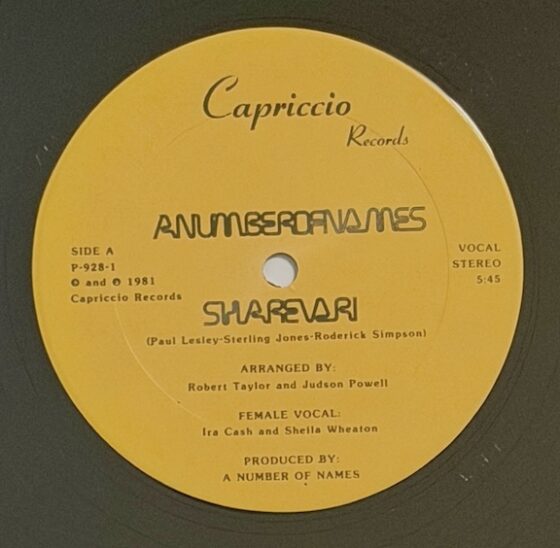
Issued in Detroit in 1981 by Capriccio Records as a 12-inch single (P-928). Side A contains the vocal version of “Sharevari,” while Side B contains the instrumental version.

Edition & Variant Identification

Original 1981 commercial pressing on Capriccio Records, manufactured through Archer Record Pressing in Detroit. The pressing is identified by the AR-6212 master number and associated Archer and L. Nix runout markings.

Later reissues, remixes, and reproductions of “Sharevari” exist, including Capriccio reissues that retain the original catalogue number. The AR-6212 inscriptions distinguish the original Archer-manufactured edition represented by the OMMA copy from those later issues.

Matrix & Pressing Data

Side A runout: AR-6212-A LNIX ARCHER 95

Side B runout: AR-6212-B LNIX ARCHER 95

Physical Description

Near MintTwelve-inch single pressed on black vinyl with yellow Capriccio Records labels. The labels present the artist as ANUMBEROFNAMES.

Factory-Origin Characteristics

The AR-6212 matrices, ARCHER 95 plant identifiers, and LNIX lacquer-cutting inscriptions are manufacturing characteristics of the original Detroit pressing. The yellow Capriccio labels and P-928 side designations further distinguish the issue from later reproductions and remixes.

No additional factory-origin anomalies are documented.

Condition Report

The vinyl is graded Near Mint, retaining a strong presentation with limited evidence of handling or play wear.

Sleeve condition and any associated package details are absent from the current object description and require curator documentation.

Provenance

Acquired through Discogs from Mike Trombley, operating as StayPressedRecords, on 15 April 2026.

Trombley reports that he acquired this copy directly from Juan Atkins in 2003 while working at Amoeba Music in Hollywood. According to his account, Atkins periodically brought records to the store for sale. Trombley retained the record in his collection for approximately twenty-three years before its acquisition by OMMA.

Market Context & Historical Notes

“Sharevari” came from Detroit’s early-1980s high-school party-club culture, a world of rented halls, elaborate dress codes, competing social clubs, mobile sound systems, and young Black audiences listening across categories. Paul Lesley, Sterling Jones, and Roderick Simpson drew on the electronic music circulating through the city, including German electronic pioneers Kraftwerk, European disco, new wave, funk, and the borderless programming of the Electrifying Mojo radio DJ, and fashioned it into a record about their own surroundings. Its title invokes the Charivari party club; its catalogue number, P-928, echoes the Porsche 928 celebrated in the lyric.

The music features a taut electronic pulse, synthesized bass, handclaps, processed voices, and an amused continental delivery describing bread, cheese, white wine, fashion, and expensive cars. Its European references became raw material for an unmistakably local creation: Black American electronic dance music built from imported sounds, Detroit technology, and the city’s youth culture.

“Sharevari” appeared alongside Cybotron’s “Alleys of Your Mind” at the opening edge of Detroit techno, years before the genre acquired a settled name and international infrastructure. Later records by Juan Atkins, Derrick May, Kevin Saunderson, and their contemporaries would define the form with greater precision, yet the essential transformation is underway on P-928. Electronic pop, independent pressings, and a regional party record for the local social scene helped became the source of a global musical movement.

Canonical Status in OMMA

OMMA recognizes “Sharevari” as one of the earliest commercial recordings in the Detroit techno lineage and a foundational document of Detroit’s transition from post-disco club culture into machine-based electronic dance music.

Historians are unclear as to whether “Sharevari” or Cybotron’s “Alleys of Your Mind” serves as the first techno record, the emergence of both appears to have launched the scene and the genre.   

References and Source Documentation

Discogs, “A Number of Names – Sharevari” — original Capriccio P-928 release, credits, label matrices, runout inscriptions, and Archer manufacturing identification.

Tremble Under Boom Lights, “Archer Record Pressing Master Numbers” — AR-6212 identification, surviving invoice description, and comparison with the Archer number associated with Cybotron’s “Alleys of Your Mind.”

Resident Advisor, “A Number of Names: Sharevari — Single Review” — historical assessment of the original pressing, musical construction, and Detroit techno context.

AllMusic, “A Number of Names Biography” — group personnel, recording credits, Charivari history, and the Electrifying Mojo account.

Red Bull Music Academy Daily, “Theater of the Mind: The Legacy of the Electrifying Mojo” — Mojo’s role in Detroit radio and his early support of “Sharevari.”

Music Origins Project, “Teen Party Clubs Like Charivari Started the Techno Movement in Detroit” — history of Detroit’s high-school party clubs and the local environment surrounding “Sharevari.”