
DJ Playero
Listen37 Underground — continuous programme · 1993
DJ Playero — 37 Underground, the shortened programme in continuous playback.
Listen on YouTube ↗
1993 · Unofficial Dominican-market duplicate
Playero 37
Playero 37 travelled through copied cassettes, informal shops and listeners carrying music across borders. This Dominican-market copy preserves one of those journeys: its previous owner bought it during a visit to the island in spring 2001.
| Accession | OMMA-0044 |
|---|---|
| Artist | DJ Playero |
| Release | 1993 · Puerto Rico · Dominican-market copy |
| Label | Unofficial Dominican-market duplicate · No catalogue number |
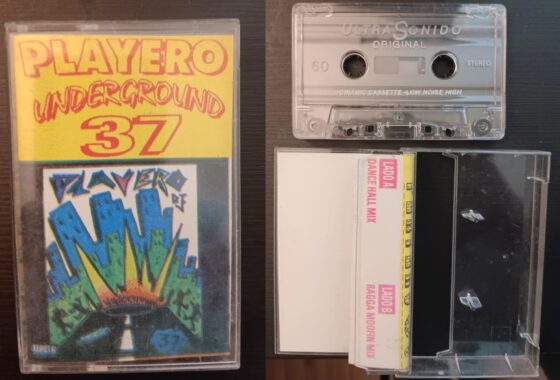
| Format | C-60 compact cassette |
| Issue | Circulation copy purchased in spring 2001 |
| Shell marking | Ultra Sonido Original |
| Recorded grade | NM cassette and J-card |
Release history and significance
Before reggaeton became a worldwide name, Playero’s music circulated as Puerto Rican “underground.” Filmmaker Omar Acosta remembered looking for the DJ’s car in San Juan to buy tapes directly from him. He bought Playero 37 before moving to New York and recalled the excitement of hearing Spanish-language voices over rhythms that felt familiar and startling at once. [1]
The programme brought together performers including Daddy Yankee, Master Joe and O.G. Black. Its continuous mixes let one voice follow another, making the cassette a meeting place for a developing scene as well as a way to hear it outside Puerto Rico. [1] [2]
The original programme dates to around 1993. A shorter Play Underground edition, catalogued in 1994, pairs “Dance Hall Mix” and “Ragga Moofin Mix” for a total of about forty-six minutes. This later C-60 duplicate carries a shortened programme and belongs to the informal distribution history of the recording. [2]
Market context
For the distinct 1994 Play Underground PG-001 cassette, Discogs lists sales from US$23.26 to US$50, with a median of US$35, as recorded on 13 September 2026. The latest recorded sale was 9 June 2025. [2]
Physical Description
A generic C-60 cassette shell marked “Ultra Sonido Original,” accompanied by a reproduced Playero 37 J-card. It is a locally circulated duplicate, distinct from the earlier Puerto Rican issue.
Condition
The cassette and J-card are graded Near Mint. A digital transfer of playback has clear sound.
Provenance
Acquired from Cormac Symington on 28 August 2025.
In his written account, Symington recalled first encountering Playero tapes while living in upstate New York during the 1990s. In spring 2001 he travelled to the Dominican Republic and stayed with family friends in San Pedro de Macorís. Already looking for Playero recordings and related dancehall, he bought this cassette at a small informal music shop, most likely in San Pedro de Macorís. [3]
Sources
- Paula Mejía, The FADER, Reggaeton Conquered the World. Omar Acosta’s recollections of buying Playero tapes and their international circulation.
- Discogs, Playero D.J. — 37 Underground, release 6074389. 1994 Play Underground PG-001 cassette, programme and sales history; a reference edition distinct from the Dominican duplicate.
- Cormac Symington, written provenance statement. Firsthand recollection of the spring 2001 purchase.
Catalogue text reviewed 13 September 2026.