
Sonny Boy Williamson I
A defining voice of blues harmonica, captured at his first recording session.
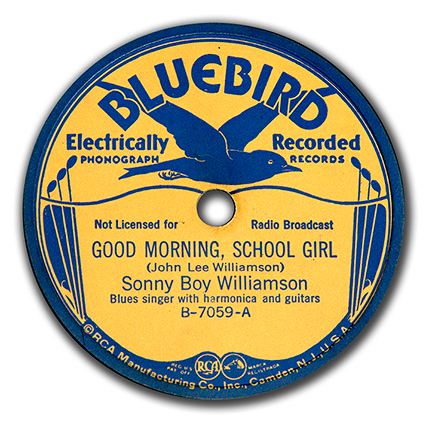
ListenGood Morning, School Girl · 1937
Sonny Boy Williamson I, “Good Morning, School Girl.” Listen on YouTube ↗
1937 · Bluebird
Good Morning, School Girl Sugar Mama Blues
Two sides from John Lee Williamson’s first recording session, with Big Joe Williams and Robert Lee McCoy on guitars. The record that helped make the harmonica a leading voice in the blues survives here in a copy from the collection of Chris Strachwitz, founder of Arhoolie Records. [1] [2] [5] [6]
| Accession | OMMA-0156 |
|---|---|
| Artist | Sonny Boy Williamson (John Lee Williamson) |
| Release | July 1937 · United States |
| Label | Bluebird · B-7059 |
| Format | 10-inch shellac single · 78 rpm |
| Issue | U.S. commercial issue · buff-and-blue flying-bird labels |
| Runouts | Not documented |
| Recorded grade | A-side E+ · B-side E− (Tefteller auction grades) |
Release history and significance
John Lee Williamson brought the harmonica to the foreground of the blues and pioneered the harmonica-led small bands that helped shape the sound of postwar Chicago. [9] His phrasing joined voice and harmonica into a continuous musical conversation, carrying the instrument from an accompanying role toward the centre of the band. Little Walter and Junior Wells were among the players who followed the path he opened. [1]
On 5 May 1937, Williamson recorded for Bluebird at the Leland Hotel in Aurora, Illinois. Big Joe Williams and Robert Lee McCoy, later known as Robert Nighthawk, supplied the guitars. “Good Morning, School Girl” and “Sugar Mama Blues” came from that debut session and were paired on B-7059, issued that July. [1] [3]
“Good Morning, School Girl” drew on a melody already circulating in the blues of west Tennessee. Williamson made it his own through the interplay of his vocal delivery and swinging harmonica lines. The Blues Foundation traces the recording to his Tennessee roots and his work with musicians in St. Louis, and recognizes its enduring influence on Chicago blues. Often retitled “Good Morning Little Schoolgirl,” the song became a blues standard. [1] [2]
Rice Miller later appropriated Williamson’s performing name and became known as Sonny Boy Williamson II. [9]
Market context
A buff-label Bluebird 7059 copy described as E / E−V+ sold for US$504 on 2 May 2017, as recorded by Popsike. This provides a dated comparison for a well-preserved copy of the same issue. Side-by-side condition and documented provenance are relevant to comparisons; the original manufacturing quantity remains undocumented. [7]
Physical Description
A ten-inch shellac 78 with Bluebird’s buff-and-blue flying-bird label design. The A-side is “Good Morning, School Girl”; the reverse is “Sugar Mama Blues.” The labels credit Sonny Boy Williamson under the name used on his original recordings. [4] [8]
Condition
John Tefteller’s auction catalogue grades “Good Morning, School Girl” E+ and “Sugar Mama Blues” E−. These are retained in the catalogue’s 78-rpm grading terminology. The accompanying sleeve is ungraded, and no separate playback assessment is recorded. [5] [8]
Provenance
From the collection of Chris Strachwitz, founder of Arhoolie Records. Strachwitz’s work recording and preserving vernacular music gives this copy a connection to the later history of blues documentation as well as to Williamson’s beginnings. [5] [6]
Acquired by OMMA from John Tefteller as lot 213 in the second Chris Strachwitz Pre-War Blues 78s auction, which closed on 1 October 2026. [5] [8]
Sources
- Keith Briggs, notes to Sonny Boy Williamson, Complete Recorded Works, Vol. 1 (1937–1938), Document Records. Debut session, personnel and harmonica influence.
- Blues Foundation, “Good Morning, School Girl” — Sonny Boy Williamson (No. 1). Musical origins and historical significance.
- Stefan Wirz, Illustrated John Lee “Sonny Boy” Williamson discography. Bluebird B-7059 release date and session details.
- Discogs, Sonny Boy Williamson — Good Morning, School Girl / Sugar Mama Blues (release 4845493). Issue identification.
- John Tefteller, Chris Strachwitz Pre-War Blues 78s auction #2, 1 October 2026, lot 213. Collection provenance and E+/E− grades.
- Smithsonian Folkways, “Smithsonian Folkways Acquires Arhoolie Records”. Chris Strachwitz and Arhoolie’s preservation work.
- Popsike, Bluebird 7059 auction result, 2 May 2017. Historical sale and seller’s condition description.
- OMMA accession record and supplied label photograph, OMMA-0156. Copy identification and acquisition from John Tefteller.
- Jim O’Neal, Blues Foundation, Sonny Boy Williamson (No. 1) (John Lee Williamson). Harmonica-led ensembles, musical influence and Rice Miller’s use of Williamson’s performing name.