
Seo Taiji and Boys (서태지와 아이들)

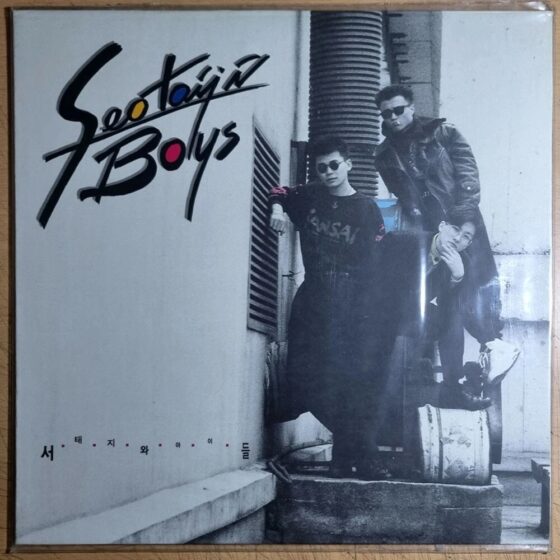

OMMA Catalogue Number
OMMA-0067
Artist
Seo Taiji and Boys (서태지와 아이들)
Title
Seo Taiji and Boys (서태지와 아이들)
Release Details
Issued in South Korea on 23 March 1992 by Bando Records as a 12-inch LP (BDL-0023). The ten-track album opens with “Yo! Taiji!” and “난 알아요 (I Know) (Club Mix),” followed by “환상속의 그대 (You, in the Fantasy),” “너와 함께한 시간 속에서 (In the Time Spent With You),” and “이 밤이 깊어가지만 (As the Night Goes On).” Side B contains “내 모든 것 (My Everything) (Live Mix),” “이제는 (Now),” “Blind Love,” “Rock ’N Roll Dance (’92 Heavy Mix),” and “Missing.”
Edition & Variant Identification
Original 1992 Korean commercial LP issue on Bando Records, catalogue number BDL-0023.
Matrix & Pressing Data
Online sources identify multiple 1992 Bando listings but because this specific copy is factory sealed the runouts are not able to be evaluated.
Physical Description
Twelve-inch Korean vinyl LP housed in its original full-color picture sleeve and sealed in factory shrink wrap.
Factory-Origin Characteristics
No factory-origin anomalies or distinguishing manufacturing characteristics are documented in the present record.
Condition Report
Mint sealed version, with sharp corners and intact shrink wrap. Media presumed mint.
Provenance
Acquired through Discogs from South Korean seller KR-VINYL on 13 February 2026.
Market Context & Historical Notes
On 11 April, 1992, in a legendarily breakthrough moment, Seo Taiji and Boys performed “난 알아요 (I Know)” on Korean national television. The program’s judges panned them, awarding them the lowest score of the evening. The song, however, a radical departure from traditional trot music and pop ballads that then dominated Korean airwaves, sparked something new in Korean popular culture. It remained at the top of domestic charts for months while the album sold approximately 1.7 million copies across formats.
Seo Taiji came from Korean heavy metal, having played bass with Sinawe before immersing himself in samplers, MIDI programming, rap, and American dance music. With dancers Yang Hyun-suk and Lee Juno, he created a form of Korean youth music inspired by hip-hop and flavored with new jack swing, hip-hop, techno, pop, and distorted rock guitar. The group’s Korean-language rap, synchronized choreography, streetwear, and artist-directed production changed the sound and social center of the national music industry.
The international K-pop system emerged through later companies, training programs, and increasingly global ambitions. This band, and this album in particular, launched much of what distinguishes K-Pop today, including multi-member groups organized around hybrid production, visual performance, intense youth identification, and continual reinvention. Yang Hyun-suk would later start YG Entertainment, while generations of artists carried the model up to the global era of BTS. 서태지와 아이들 stands at the head of that history as the South Korean album whose national revolution became the opening chapter of the worldwide KPop movement.
Canonical Status in OMMA
OMMA recognizes 서태지와 아이들 as the canonical Seo Taiji and Boys debut and the primary origin object for modern K-pop. It is the group’s first commercial album, the first physical home of “난 알아요 (I Know),” and the record through which Seo Taiji, Yang Hyun-suk, and Lee Juno entered Korean popular culture as a group.
References and Source Documentation
Discogs, “Seo Taiji N Boys – 서태지와 아이들” — original Bando BDL-0023 release identification, date, format, and track configuration.
Pitchfork, “Seo Taiji and Boys: Seo Taiji and Boys Album Review” — historical analysis of the album, television debut, sales, musical synthesis, audience shift, and influence on the later K-pop industry.
The Korea Herald, “K-pop Still Feels Impact of Seo Taiji & Boys” — contemporary Korean retrospective marking the twentieth anniversary of the group’s 23 March 1992 debut.
The Korea Herald, “K-pop Pioneer Seo Taiji’s 30 Years Remembered in 30 Hits” — career chronology and the historical position of “I Know.”
The Korea Herald, “K-pop Invasion: From a Local Trend to a Global Cultural Phenomenon” — discussion of the group’s role in establishing the foundation of the contemporary K-pop industry.
The Korea Times, “K-pop Game Changers” — account of the group’s influence on Korean youth culture and the industry’s subsequent turn toward younger audiences.
Rolling Stone Australia, “Seo Taiji and Boys, ‘Nan Arayo (I Know)’ (1992)” — assessment of the song’s new jack swing synthesis and its influence on later Korean pop groups.
Billboard, “10 Essential K-pop Boy Bands You Need to Know” — identification of the group’s 1992 debut as a formative event in the Korean idol-pop tradition.