
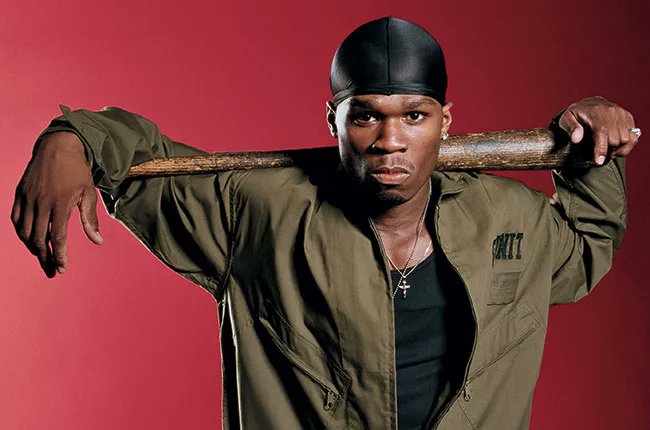
50 Cent
50 Cent, the name Curtis James Jackson III chooses to perform and live under, is a double-edged metaphor. On one level, it is an homage to Kelvin “50 Cent” Martin, a Brooklyn stick-up man whose reputation for brutality traveled through the New York City underground. “I’m the same kind of person 50 Cent was,” his rapping namesake has said. “I provide for myself by any means,”
On another, it is a metaphor for change. Jackson had already flipped a three-to-nine-year prison sentence into just over six months in a shock-incarceration boot camp where he earned his GED. He intended to keep changing his circumstances by any means available. “If my record don’t sell,” he rapped on an early, failed LP, “I’ll rob and steal.” Everything for 50 Cent is a hustle. He’s made it pay off.
The circumstances that produced the person who has now become the centi-millionaire rap and film mogul have been recounted in interviews, biographies, and his memoir, From Pieces to Weight, but the story never fails to land. Jackson, born in 1975, was raised in South Jamaica, Queens, by his mother Sabrina, a young crack dealer with status in the neighborhood. When Fifty was eight years old, Sabrina died in a suspicious house fire. Jackson has said he believes someone slipped something into her drink, turned on the gas, and left her to die. The killing remains unsolved. He moved in with his grandparents in a small house already crowded with other children, just as the crack tsunami hit the city. By his own account, Jackson started selling crack at twelve, operating under the nickname Boo-Boo. He boxed at a local gym and briefly competed in the Junior Olympics, but the streets drew him in. By the time he was in high school he was skipping class to make drug runs. At seventeen he was cutting product in his grandmother’s house; by his late teens he was moving enough product to buy luxury cars and jewelry and ran his own territory, sometimes brutally.
By 1994 big trouble had found him. Jackson was arrested after selling vials of crack to an undercover officer, then again when police raided his home the found much more. The state was seeking nine years. Instead, he took a plea that sent him to a six-month “shock incarceration” boot camp, a military-style program that mixed physical drills, discipline, and GED classes. He completed the program, earned his high-school equivalency, and walked out with a new sense that he couldn’t keep playing exactly the same game. The pull of the street didn’t evaporate, but the idea that he might convert the same aggression and discipline into something else started to feel less abstract.
Rap, always in the air around him, began to look like a workable route. Jackson started freestyling in basements, recording verses over other people’s instrumentals on cheap tape decks. A friend introduced him to Jason Mizell, better known as Jam Master Jay, the DJ and producer who was part of the global superstar group Run-DMC. Mizell signed him to his JMJ label in the mid-1990s and began the slow work of shaping Fifty’s raw bravado into songs. Jam Master Jay taught him how to count bars, write hooks and structure verses.They recorded in modest Queens studios and Jay’s own space, working up an album’s worth of material. In 1997 JMJ Records slipped out a 12-inch single, “The Glow” backed with “The Hit,” which caught the ears of DJs and record label talent scouts. A year later, Jackson’s voice turned up on “React,” a track by Jam Master Jay’s most successful group, Onyx. The placement gave him credit on a platinum act’s LP, but the momentum stalled. Fifty kept getting sidelined. His album with JMJ never materialized, communication broke down, and Jackson’s relationship with members of Onyx soured after one of them stole the spotlight to perform Fifty’s verse onstage at the Apollo.
Fifty’s work, however, got the attention of Columbia Records. By the late 1990s the label, working through the producer duo Trackmasters, was looking for another hard-edged New York rapper who could bridge the street and the mainstream. Jackson fit, signing on to work on what was intended to be his debut album, Power of the Dollar. With Trackmasters shaping the sound, the sessions took him out of the neighborhood studio and into a higher-end, R&B-polished world. Beyoncé, then an up-and-comer with Destiny’s Child, sang on one of the tracks.
The breakthrough, oddly, came not with a glossy single but with a gleeful, antagonistic joke. In 1999 Columbia issued “How to Rob,” a dark, comic fantasy in which 50 Cent imagines robbing a parade of famous rappers and R&B stars. Over a Trackmasters beat, he outlines stickups of everyone from Jay-Z and the Wu-Tang Clan to Mariah Carey (who threatened to quit the label if her name wasn’t dropped. It was.) The song first appeared on the soundtrack to the crime film In Too Deep and then as a planned lead single for Power of the Dollar. It put Fifty squarely in the center of the conversation. Every artist named in the song had to decide whether to ignore this unknown kid from Queens or answer back. Many chose the latter. Jay-Z slipped a warning line into “It’s Hot (Some Like It Hot),” others fired small shots on mixtapes and radio freestyles. Missy Elliot humorously thanked him in the liner notes of her next record. The controversy announced 50 Cent as both an instigator and a threat, someone willing to poke the very ecosystem he hoped to enter into.
Power of the Dollar was nearly ready. Videos were filmed. Singles like “Thug Love (feat. Destiny’s Child)” and “Rowdy Rowdy” circulated, especially on the East Coast. Internally, Columbia saw Jackson as a bet on the post-Biggie, post-Pac generation of gritty New York rap. Everything collapsed that spring. On a May afternoon outside his grandparents’ house in South Jamaica, a gunman opened fire at close range. Jackson was hit nine times, in the hand, arm, hip, both legs, chest, and face. He spent nearly two weeks in the hospital and months in physical therapy relearning how to walk, his voice permanently altered by a bullet that passed through his cheek. The shooting was widely reported in the hip-hop press, with much evidence suggesting it was ordered by murderous drug kingpin Kenneth “Supreme” McGriff because he was dissed in one of Fifty’s tracks. Columbia Records, spooked by the violence, dropped him. Power of the Dollar was shelved. Only promos and bootlegs would circulate.
Jackson was convalescing, blacklisted in the industry, on the outs with much of the rap world that he dissed, and still very much a target in his own neighborhood by McGriff’s gang, the appropriately named Murder Inc. The solution Fifty and his team found was to record in Canada with Trackmasters affiliates, out of the reach of New York’s hitmen, stockpiling dozens of songs. In 2002 those sessions resulted in Guess Who’s Back?, a street-circulated mixtape that quietly reintroduced 50 Cent as a presence. He and his crew released a second, 50 Cent Is the Future in 2002, rapping over successful instrumentals from other rappers like Jay Z. The effect was electric and he began to own the streets. Later tapes like No Mercy, No Fear and God’s Plan deepened the effect.
The Guess Who’s Back? tape ended up in the hands of Eminem. According to multiple accounts, Eminem was struck by the intensity and songwriting, and brought it to Dr. Dre. Eminem flew Jackson to Los Angeles, had him audition in person, and within weeks 50 Cent had a joint deal with Shady Records, Aftermath Entertainment, and Interscope. For a rapper who had been informally banned from some major-label offices only a year earlier, the pivot was extraordinary. The industry pariah had become a centerpiece of a new era’s most powerful rap partnership.
Before the album came the soft launch. Fifty’s “Wanksta,” a mixtape cut, was added to the soundtrack of Eminem’s semi-autobiographical film 8 Mile, giving 50 Cent his first major-label single and his first solo radio record. By early 2003, anticipation for a proper debut had reached a point where the major album release, Get Rich or Die Tryin’, was a foregone conclusion.
The album arrived on February 6, 2003. Get Rich or Die Tryin’ debuted at No. 1 on the Billboard 200, selling nearly 900,000 copies in its first week and almost as many the second. The lead single, “In da Club,” dominated radio and MTV, sitting atop the Billboard Hot 100 for nine weeks and becoming one of the defining songs of the decade. By the time the first-week sales numbers came in, the metaphor embedded in the name 50 Cent no longer needed explanation. Curtis Jackson had taken everything that was supposed to end him – poverty, street life, his mother’s murder, the crack years, the arrest, the nine bullets, multiple record-label rejections – and changed it into a debut that paved his path to the wealth and stardom he rapped about.
by Sean Ransom – January 13, 2026