
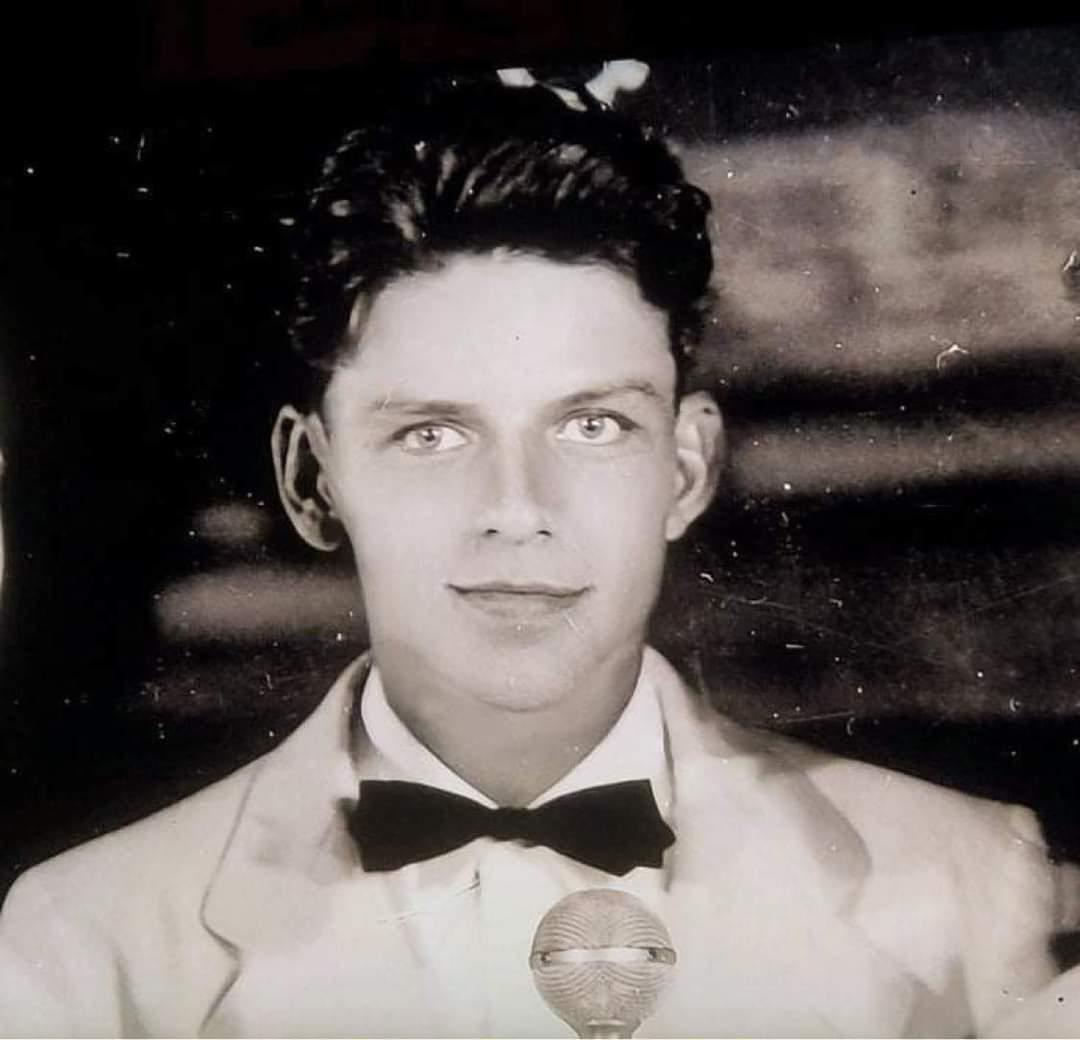
Frank Sinatra
In 1939, Harry James had the world in his hands. The virtuoso trumpeter for the world-famous Benny Goodman Orchestra had wowed Carnegie Hall the year before, bringing the high-flying circus of swing music into stiff, highbrow venue, warming the crowd with electrifying play still renowned by jazz historians. His decision to become his own bandleader soon after gained Goodman’s support and even his funding. And to top it off, he had just landed a new recording contract with the prestigious Brunswick label. As they said back then, the world was Harry’s oyster.
Except for one thing.
He needed a male singer, someone who could stand out in a crowd of crooners.
Enter Frank Sinatra, child of Italian immigrants and high school dropout with a dream: To do what his idol Bing Crosby had done and make it big as a singer. Sinatra’s talent was undeniable: In 1935 he hit it big in the country’s greatest nationwide talent show, The Major Bowes Amateur Hour, but another group from his hometown of Hoboken had also auditioned and producers wouldn’t put two acts on from the same town. Sinatra had to join the trio or be cut. The resulting group, The Hoboken Four, was riven by jealous bullying. Sinatra left the group mid-tour only to end up at The Rustic Cabin, a New Jersey roadhouse where he starred as a singing waiter. The Cabin, though, had one thing that could give Sinatra a break: A wire connected to radio station WNEW in New York City. Occasionally, the band’s sets were broadcast live over the airwaves. If he sang well enough, he thought, someone important might be listening.
By June 1939, the Harry James Orchestra had yet to turn a profit and the beautiful promise of all Harry had built was starting to look precarious. One night in his hotel room, James’s wife, Louise Tobin, tuned the radio to a live broadcast from The Rustic Cabin where Sinatra was entertaining the clientele for $15 per week. “Harry, you might want to hear this kid on the radio,” Tobin said. “The boy singer on his show sounds pretty good.”
James drove the next day from New York City to New Jersey. The setting was small, but Sinatra’s phrasing and control made an impression strong enough that James wanted to offer him a two-year contract on the spot, but he had one major reservation. “Sinatra” was too Italian. To Harry James, the name sounded too ethnic and too hard for American audiences to remember. He wanted something smoother—something that sounded like a crooner.
James suggested a stage name: “Frankie Satin.”
Despite being a nobody with almost no leverage, Sinatra refused. “I’m sorry,” Sinatra told him, “but I was born Sinatra, and I’ll die Sinatra.” It was an early glimpse of the stubborn pride that would define his entire career. Surprisingly, James relented. He signed “Frank Sinatra” to a contract for $75 a week.
Less than a month later, the 23-year-old singer entered the studio with Harry James and His Orchestra to record two songs for Brunswick: “From the Bottom of My Heart” and “My Melancholy Mood.” The vocals are described by historians as “tentative,” the sound of a singer who hasn’t yet fully settled into the relaxed authority he would later project with the Tommy Dorsey Orchestra, whom Sinatra joined just six months after meeting James, or after the war, at Columbia and Capitol.
But the ingredients are already present. Sinatra’s pitch is centered, his diction crisp, his breath control intact. There is less rubato, less of the conversational looseness that would become his signature, and more of an almost formal precision that reflects the big-band context he was entering.
The band, for its part, is exactly what Brunswick hoped Harry James would deliver: tightly voiced brass figures, a polished rhythm section, and the occasional climbing trumpet line that reminded listeners why James had been such a star with Goodman.
Brunswick 8443: A modest catalog entry
Brunswick issued the two songs together as a 10-inch shellac 78 rpm disc, catalog number 8443, with “From the Bottom of My Heart” on one side and “My Melancholy Mood” (often listed simply as “Melancholy Mood”) on the other.
The standard label design is familiar – black with silver print, “Brunswick” in its stylized script at the top, patent information above the spindle hole. Above the song title, in smaller type, a phrase that is now historically significant but then was simply a line of credit: “Vocal Chorus Frank Sinatra.”
At the time, it was just another entry in the Brunswick jazz and dance-band line. It did not chart or become a jukebox staple. Contemporary accounts and Sinatra’s own official site note that neither side made any commercial impact.
The record did, however, sit at a transition point for the label itself. By the end of 1939, Brunswick’s American pop line was being wound down under its new CBS ownership, with Columbia increasingly taking over front-line releases. The Sinatra debut is among the last of the U.S. Brunswick pop issues before the imprint effectively passed into history.
Sinatra recorded a handful of additional releases with Harry James in the second half of 1939, but their partnership was short. In early 1940, he left James to join Tommy Dorsey’s band, trading a smaller, developing outfit for one of the most visible swing orchestras of the era. Dorsey records such as “I’ll Never Smile Again,” “I’ll Be Seeing You,” and “I’ll Be Around”quickly overshadowed the James records in the public mind, and Brunswick 8443 fell back into the undistinguished mass of pre-war 78s.
by Sean Ransom – Dec. 10, 2025