
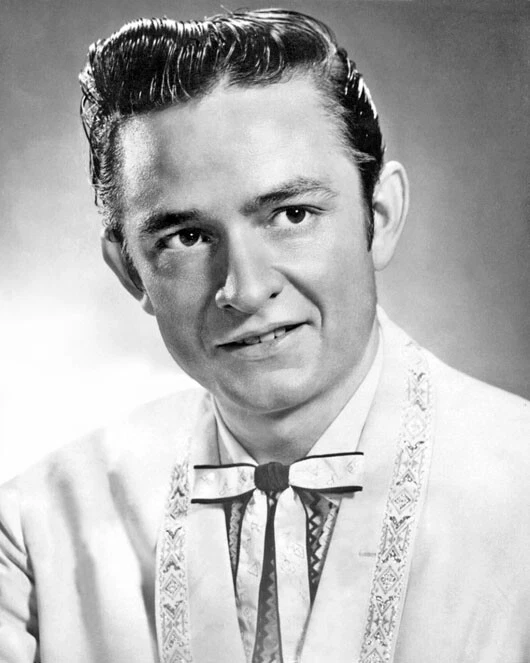
Johnny Cash
In the spring of 1955, Johnny Cash stood in a Sun Records studio with nothing but two bandmates and a guitar he’d bought for $5 during his United States Air Force service in Germany. The scene marked the official conception of his recording career and converged two complementary influences: Southern working-class heritage and Sun Records’ commercial expertise.
He’d loved music his whole life. As a child, he absorbed work songs as he tended to the fields of his family’s cotton farm and hymns from his devout Pentecostal mother. In the evenings, he dialed into the Memphis radio stations to hear country and blues. By the time he was twelve, he’d already begun writing songs that unified the two genres into a distinctly American style. Music represented an escape from his family’s impoverished life in rural Arkansas. He’d long dreamt of a music career, but it wasn’t until his military deployment that he solidified his commitment to that dream.
In Germany, he formed a band and wrote songs incessantly, including his eventual hit, “Folsom Prison Blues.” Music became his all-consuming ambition. When Cash returned, he visited his brother Roy in Memphis, who was working at a mechanic shop with three informal musicians: Luther Perkins, Marshall Grant and A.W. “Red” Kernodle. Upon meeting, they formed a group and began playing gospel songs in each other’s homes and at occasional shows. They developed their signature “Boom-Chicka-Boom” style in those early days as Luther Perkins muted his Fender Esquire strings with his hand and Marshall Grant hit the upright bass. These techniques produced a train-like rhythm that defined Johnny Cash’s music.
Meanwhile, Cash persistently called highly esteemed Sun-Records founder Sam Phillips, who’d just struck major success with his new artist, Elvis Presley. Cash was turned away at every attempt. Tired of rejection, he spontaneously took his bandmates up to Sun Records and sat outside of Phillips’ door until he arrived, at which point Cash insisted on his musical merits and demanded that he be allowed to audition. Phillips agreed.
The group auditioned on the spot with a gospel song, but an intimidated Kernodle bailed right before the audition, leaving Cash with just two members of his backup band. Even so, Phillips liked their sound. He did not, however, think their religious content was right for the times, telling Cash (in a famous but possibly apocryphal quote) to “go home and sin, then come back with a song I can sell.” Although Cash later denied Phillips used this exact language, it is true that Phillips was concerned with engineering marketable sound and lyrical content and he knew just what it took. His strategy reflected the larger music culture materializing in 1950s Memphis. Sun Records was famous for merging elements of country, blues, gospel, and rock to produce a lucrative “rockabilly” sound, and Johnny Cash would be the perfect addition to the label’s innovative work. When Phillips rejected their gospel tunes, Cash immediately pivoted and played a secular song he had already been working on: “Hey Porter!”
“Hey Porter!” emerged from Cash’s Air Force days, inspired by his own train ride home following his discharge. It featured Cash’s key distinctives: boom-chicka-boom rhythm, twangy vocals, and masterful storytelling. The song even included a uniquely endearing characteristic of Cash’s music: American geography. Many of his later songs would chart narratives onto particular cities or detail Cash’s travels across regions. From Minnesota to California to Mississippi, Cash told American stories. This one was no different. “Hey Porter!” tells the story of a passenger headed home to Tennessee by train who continually asks the porter for updates as they near the Mason-Dixon line, obviously inspired by Cash’s own pride in his southern heritage.
Phillips liked the sound, but he needed a second song to press a record. A few months after this initial audition, Johnny Cash and the Tennessee Two returned to Sun Records to officially record “Hey Porter!” alongside a brand new track: “Cry! Cry! Cry!” This second song stemmed from another of Phillips’ musical demands. This time, he wanted a love song or “a bitter weeper,” so the band went home and wrote it overnight. The ballad is written from the perspective of a man whose lover has cheated on him as he confidently pronounces the consequences that will follow her betrayal. Cash’s voice is raw as he relays the narrative, which gives the song an unmistakably authentic feel that listeners came to adore. This is perhaps one reason why Phillips’ last recommendation was the most lasting: Instead of calling themselves “The Tennessee Three,” as they had planned, Phillips suggested that they call themselves Johnny Cash and the Tennessee Two. This name, which highlighted Cash’s unique style and charisma, stuck.
Phillips’ formula produced immediate success: People fell in love with Cash’s engaging style, and the song instantly rose to the 14th spot on the country music charts, becoming the first of many hits. Cash had officially unlocked the sound that would make him into a country superstar and a timeless American sensation: much lay ahead for the man in black.
by Libby Northup – May 14, 2026