
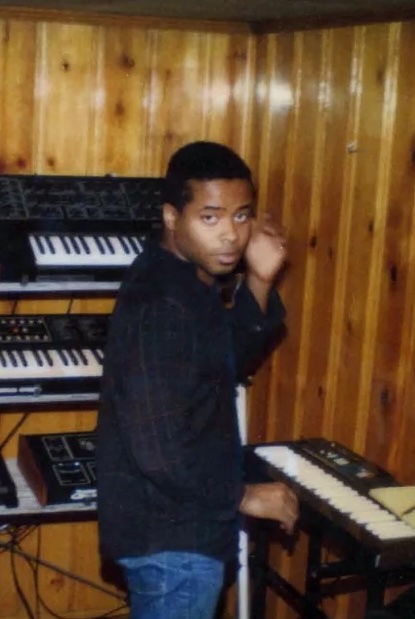
Juan Atkins (Cybotron and Model 500)
The storied Grinnell Brothers Music House, a massive, architecturally significant building in Detroit’s Lower Woodward Avenue Historic District, has seen a lot of history, but among the most significant was when a teenaged Juan Atkins would travel with his grandmother the 30-miles or so from the outlying town of Belleville and explore the back room that held the synthesizers as his grandmother bought sheet music and accessories for the Hammond B3 organ she kept in her house.
Atkins had moved to Belleville in the 1970s from Detroit’s east side after his parent’s split, but the young man was already immersed in music life. His father was a concert promoter, organizing shows for artists like Barry White at Cobo Hall, and the younger Atkins had been playing around with the guitar and bass in funk bands inspired by George Clinton’s Parliament Funkadelic in his early teens. He was only about 15 when his his grandmother bought him one of those synthesizers he admired in Grinnell’s, a Korg MS-10.
Atkins home-brewed his own tracks with a couple of cassette decks, a four-channel mixer and tape-to-tape overdubs, eventually teaching himself to be an electronic music maestro. High school friends would come over and they would listen to music together from places near and far, a pastiche of world-shaping sounds as familiar as Prince to exotics like Kraftwerk and Yellow Magic Orchestra, while the wider late-night radio programming of Electrifying Mojo would bring in artists like Tangerine Dream and Giorgio Moroder. Although they hadn’t started making music together yet, Belleville High School friends Atkins, Derrick May and Kevin Saunderson, would later become famous as “The Belleville Three,” artists who brought Detroit techno to the world.
By 1980, the then-18 year old Atkins was showing his self-produced tapes to fellow students at Washtenaw Community College in Ann Arbor where a music class classmate, Richard “Rik” Davis, heard them and invited him to over to jam. Davis, a Vietnam veteran a dozen years older than Atkins, had seen horrors in the Southeast Asian jungles, but he used his GI benefits to enter college and had invested money on advanced music tech.
“I went over, with my little Korg MS‑10 under my arm,” he told music publication Sound on Sound (https://www.soundonsound.com/techniques/classic-tracks-model-500-no-ufos). “I walked into his studio, which was a bedroom in a two‑bedroom apartment. He had the lights basically off, shades down. So all I could see was the LEDs coming off the keyboards and all of the sequencers and drum machines. I thought I was going into a new dimension or something, man. I thought I was in the cockpit of an alien spacecraft.
But Atkins held his own and the collaboration that followed became Cybotron, one of the earliest pioneers of techno. Atkins founded a label, Deep Space Records, specifically to release the music, and the first single, “Alleys of Your Mind” with “Cosmic Raindance” on the B-side, landed in 1981. This as well as later music, including their foundational breakthrough hit “Clear” and the 1984 single “Techno City” that all but named the genre, catapulted Cybotron to fame.
Creative differences led Atkins and Davis to split. Davis wanted to add more psych-rock and guitar textures to the work while Atkins leaned harder into the electronic sound. By 1985, Atkins had set up his own studio – Metroplex Soundworks – and started a namesake label, Metroplex, that would eventually become legend. It was at these boards and synths that Atkins mixed his first works under his new stage name, Model 500, and where the roots of techno truly take shape, on a 12” single called “No UFO’s” decorated with Atkins’ own hand-drawn label.
Atkins’ friend Derrick May would visit his parents in Chicago and while there May passed Atkins’ record on to DJs in the Chicago club scene. The copies started a phenomenon. DJs like Farley “Jackmaster” Funk at The Playground and Frankie Knuckles at the Power Plant, who usually played European beats, started spinning Atkins’ disk and the sound that would quickly be called Detroit Techno started killing it on Chicago radio stations, soon to be picked up from there by the British labels and then spread worldwide.
by Sean Ransom – April 6, 2026