
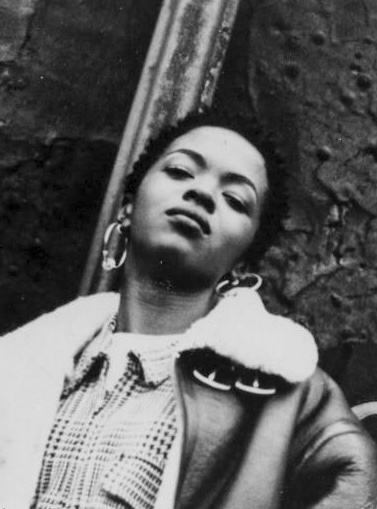
Lauryn Hill
Amateur Night at the Apollo, 1988, and Lauryn Hill, age 13, is about to sing “Who’s Lovin’ You” by the Jackson 5 on one of New York City’s most intense stages. “We can offer them what no one else offers them — the power of the boo,” an Apollo staffer named only “Executioner,” told Rolling Stone magazine. The Apollo audience is anything but shy. Executioner admits he feels bad for some of the performers, but he is the one responsible for ushering failed acts off-stage. “Some people really can sing,” he said, “they just decide on wearing the wrong outfit. ‘We don’t like them gold lamé shoes? Boo!’”
Lauryn Hill experienced this environment first-hand. Booed by the crowd due to an initially rocky start, nervous voice alternating between flat and pitchy, Hill kept singing anyway, even growing in confidence instead of shying away. She won the crowd over by the end, leading to applause, and this performance is frequently cited as a defining moment in her career that showed her grit and early talent. In later years (after her debut albums) she was invited back to the Apollo as a guest performer in the 1990s and in 2015.
Her grit as a performer and as a person is evident throughout her entire life. At Columbia High School in Maplewood, New Jersey, she founded the school’s gospel choir and classmate Pras Michel invited her into a high school band. That band – the Tranzlator Crew, later known as The Fugees – became a trio that would become best-sellers in hip-hop. Pras Michel, a classmate of Hill’s at Columbia High School, recruited her to sing. While not originally the group’s rapper, she built the skill by listening to and modeling her flow after male rappers, particularly Ice Cube. Pras’ cousin Wyclef Jean, a Nazarene minister’s son who grew up playing church music, joined later. They chose their original name Tranzlator Crew because they wanted to rhyme in different languages and built audience buzz through local performances. They hooked up with a local production company LeJam Productions, which led them to sign a management deal with David Sonenberg, who became their manager in the early 1990s. All of this worked together to land them a deal with Ruffhouse Records, which operated as a joint venture with Columbia Records. The high-school group was starting to go big-time.
The lead single, “Boof Baf,” landed October 19, 1993. Lauryn Hill rapped her own verse in the song. Wyclef opened “Boof Baf” with a call-and-response hook built around a Jamaican slang term for gunfire, and the entire song is dense and fast. It is a mix of early-’90s New York rap and Caribbean identity. The Fugees hadn’t perfected their rap flow yet, so some verses seem a little choppy, but overall, the single was packed with wit. The Fugees’ debut album, Blunted on Reality, released in January, 1994, did not take the world by storm. It hit Number 62 on Billboard’s Top R&B/Hip-Hop Albums chart, and failed to get much traction, selling only 12,000 copies before their breakthrough second album, The Score, hit a couple years later. Wyclef Jean spoke with Vibe magazine about their debut album: “It gave us a chance to perform all over Europe when the Hip-Hop heads was killing us in America,” Jean said. “They was like ‘This is trash.’ … We wasn’t looking at Blunted on Reality, we were looking at it as an introduction of where we wanted to go.” The group was still under the transitional name Fugees (Tranzlator Crew) and the trio did not have full creative control over their debut album. However, when the group was tasked with taking control of the wheel creatively, The Fugees began to hit their stride with their critical success.The group changed their name to the Fugees, a term used derogatorily for Haitian refugees in America that referenced both Pras’ Haitian heritage and Jean’s immigration background.
Before The Fugees had a record deal, they had to fund their local performances somehow. Lauryn Hill’s raw performance talent comes into play here: she used money from acting to help finance the early days of the Fugees before they were signed. In the years while the Fugees were developing, Lauryn Hill was making her feature film debut as an actress in Sister Act 2: Back in the Habit (1993). Lauryn Hill was cast as Rita Watson in Sister Act 2 through the film’s large nationwide casting search, which drew more than 3,000 auditions from young people across nine cities for the roles as students. Film critic Roger Ebert dismissed the film but noticed her, describing a young performer with a “big joyful musical voice.” Bill Duke, who directed it, said one of her on-screen raps was entirely unscripted and later told Andscape, “It became obvious early on that she was a generational talent in the making.” She was eighteen.
A month after “Boof Baf,” Blunted On Reality‘s first single was released, the Sister Act 2 soundtrack arrived, with Hill singing on “His Eye Is on the Sparrow” and on “Joyful, Joyful.” It put Hill on record outside the group and made it plain that her future would not be confined to one role. The voice heard in Sister Act 2 is gospel and sweet. The performer on Blunted on Reality is sharper, more combative, more concerned with momentum and force. Both versions were already present, and the distance between them was smaller than it should have been. She had enrolled at Columbia University in the meantime but left during her freshman year to manage her skyrocketing career. Within the span of a few months, Hill had appeared on record as part of a rough rap trio, starred next to Whoopi Goldberg in a major Hollywood comedy, and performed as a featured singer on a major-studio gospel number, and that was all just the start.
Works Cited
https://www.vibe.com/features/editorial/wyclef-jean-fugees-blunted-on-reality-album-1234846806/
https://www.theguardian.com/music/2013/aug/21/rocks-back-pages-lauryn-hill
By Kate Ransom – April 16, 2026