
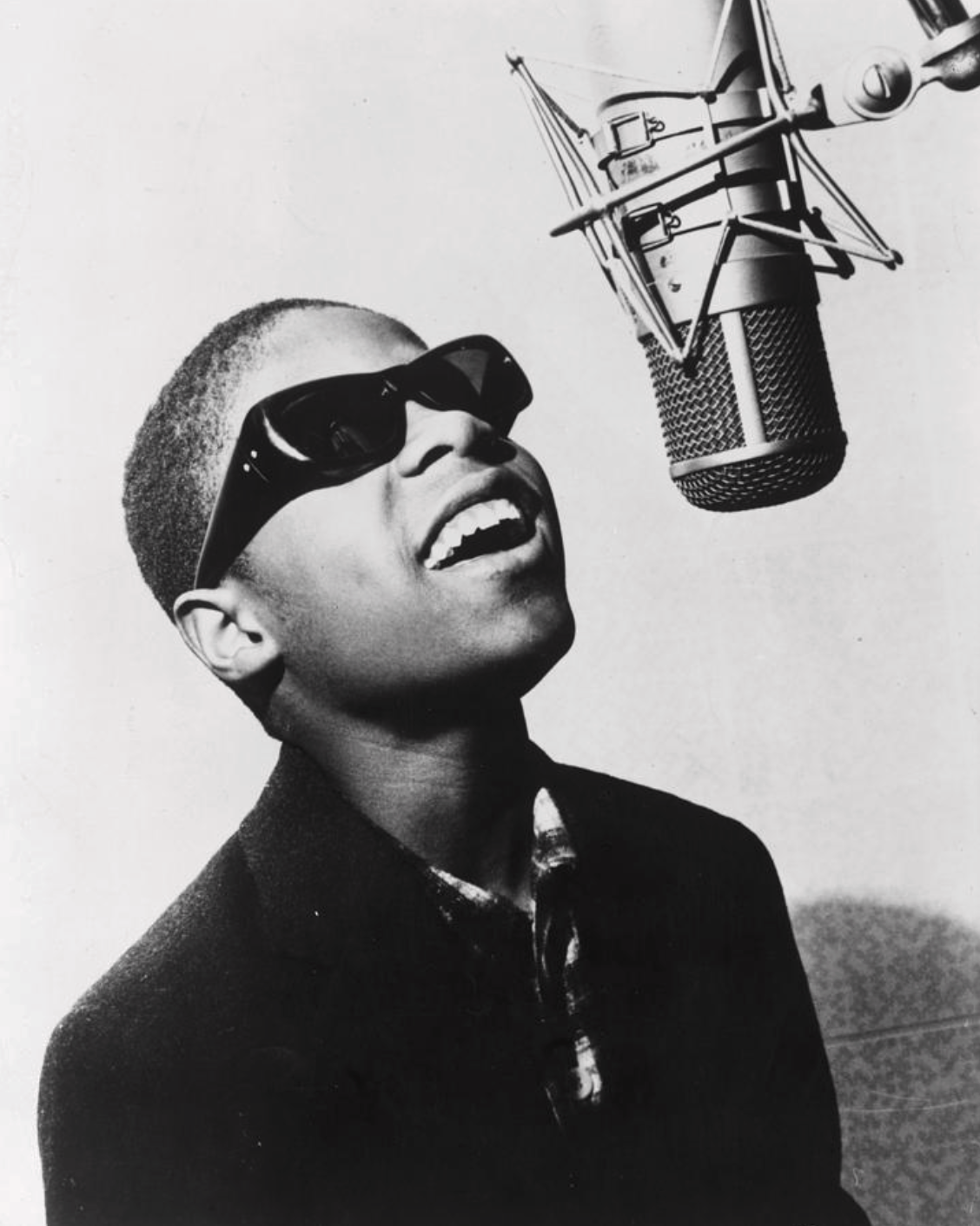
Stevie Wonder
On a summer day in Detroit, an eleven-year-old boy sat on a front porch, playing the harmonica. Smooth and bluesy notes wafted through the air, captivating the passerby who heard it. The boy was already known for two things: being a musical prodigy, and carrying a pocket-sized radio everywhere he went.
That boy was Stevie Wonder, born Stevland Hardaway Judkins (later Morris after his mother remarried) in 1950. He was born six weeks premature, causing the blood vessels in his eyes to not fully develop. Wonder was diagnosed with Retinopathy of Prematurity (ROP), and his hospital used an oxygen-rich incubator to treat him. Unfortunately, the high concentration of oxygen caused abnormal growth of his blood vessels and eventually, retinal detachment, leaving him permanently blind.
His disability didn’t hold him back from a zest for music and life. Wonder had a natural good humor, and he moved through the world with an energy people were usually surprised by. He found his neighbor’s piano and taught himself how to play by ear alone, then continued to learn drums and harmonica before age ten. He grew up playing church music at Whitestone Baptist Church, singing in the choir and becoming a featured soloist by age eight.
Raised on the sounds of Sam Cooke, R&B and jazz, Wonder listened constantly to his portable radio – between classes, at home, and eventually even between recording sessions.
According to profiles by Rolling Stone, he relied on sound almost like sight and would remember voices instantly through their tone and emotional cues. He walked into rooms confidently and disliked pity. Wonder’s reliance on his ears also caused him to fall in love with music more deeply, describing music as something constantly “alive” around him. He would study it closely, songs almost becoming a landscape he could mentally move through.
Wonder’s childhood friend John Glover became an important figure in his early life. The two performed together as “Stevie and John,” playing on street corners and at local dances around Detroit. John’s own family connections caused Stevie to get noticed, specifically by Ronnie White, who happened to be a member of the then-popular vocal group The Miracles. Glover, with the help of his brother, worked to convince Ronnie to get them an audition with his label, Motown Records. He finally agreed after Ronnie heard the 10-year-old Stevie playing a harmonica and singing at his brother’s house and was so blown away that he personally drove Stevie and his mother, Lula Mae Hardaway, down to the Motown studio. Stevie’s audition eventually drew the attention of the founder of the label himself, Berry Gordy, who was dazzled by him. Impressed with his talent, Gordy reportedly remarked, “Boy! That kid is a wonder,” which later permanently stuck as his stage name.
Signed to Motown in 1961 as “Little Stevie Wonder,” he was in the public eye before he reached puberty. Due to his age, the label ran with one story and one story only: look at the kid genius! Isn’t he so young and so genius? His first single, “I Call It Pretty Music But Old People Call It The Blues,” was co-written by Gordy and Clarence Paul and released in 1962.
Nearly every aspect of the song reinforced Motown’s marketing angle, “The Twelve Year Old Kid Genius.” The single’s rare picture sleeve features Wonder seemingly standing on tiptoe to reach a microphone too high for him. The first lyrics are “I was sitting in my classroom the other day / Playing my harmonica in a mellow way.” In the next line, his teachers are referred to as Old People. Wonder’s entire image is packaged as a mini Ray Charles (another famously blind, Black American musician) down to the blacked-out shades he wore in his album cover. Audiences usually don’t care for copies, and the single wasn’t a hit, though reviews describe Wonder’s harmonica playing between verses as “quite excellent” and well-judged. And it featured pre-fame Marvin Gaye on drums, which never hurts. Although the song was not a commercial success, it almost broke into the Billboard 100, spending one week of August at 101.
After Wonder’s first two albums had a similar fate to his first single, he shot to national fame in 1963, when at age thirteen his live recording of “Fingertips (Part 2)” hit No. 1 on the Billboard Hot 100. It made him the youngest solo artist to ever top the chart.
Motown had given Wonder incredible opportunities, but eventually, he felt trapped by his child novelty image. He was no longer content to simply perform what Motown wanted him to perform. There was not much creative freedom ever given to the young prodigy, and Wonder wanted ownership over his sound, his songwriting, and his overall musical image. Stevie always constantly experimented with sound, hearing arrangements in his head, layering sounds and rhythms, but unfortunately, he wasn’t given full creative control until after his thirteenth album in 1971, a full ten years after he first got signed. Once he gained full creative ownership of his music and a renegotiated contract, Wonder’s critical success hit its peak, beginning his “classic period” in 1972.
Over the next few decades, he would release twenty-three studio albums, four live albums, three soundtrack albums and ninety-one singles. He is one of the top best-selling music artists of all time, selling over one hundred million records, twenty-two million of those being full-scale albums, proving the wisdom in one of Stevie Wonder’s most thoughtful comments about his disability. In a 2024 podcast Wonder talked about his blindness, recalling that as a child he thought, “Maybe God has something for me that’s bigger than all this,” he said. “History proved that true.”
by Kate Ransom – May 19, 2026