
Pardey also DJed and promoted nights at Sasha’s. When he started booking The Killers there, the same songs that failed to gain attention at Roma started to make sense in a hot, crowded bar steeped in the same British guitar-pop, post-punk universe the band was drawing from. Mark Stoermer, a local guitarist working as a medical courier and already a fan of the band, began turning up at shows and soon agreed to step in on bass to replace the departing Dell Neal while Ronnie Vannucci Jr., a UNLV percussion major and wedding-chapel photographer, took over on drums after the band let Matt Norcross go. By the time the band settled into regular slots, the classic lineup was in place. They rehearsed in Vannucci’s garage or slipped into the UNLV music building after hours, using the percussion rooms as an unofficial practice space.
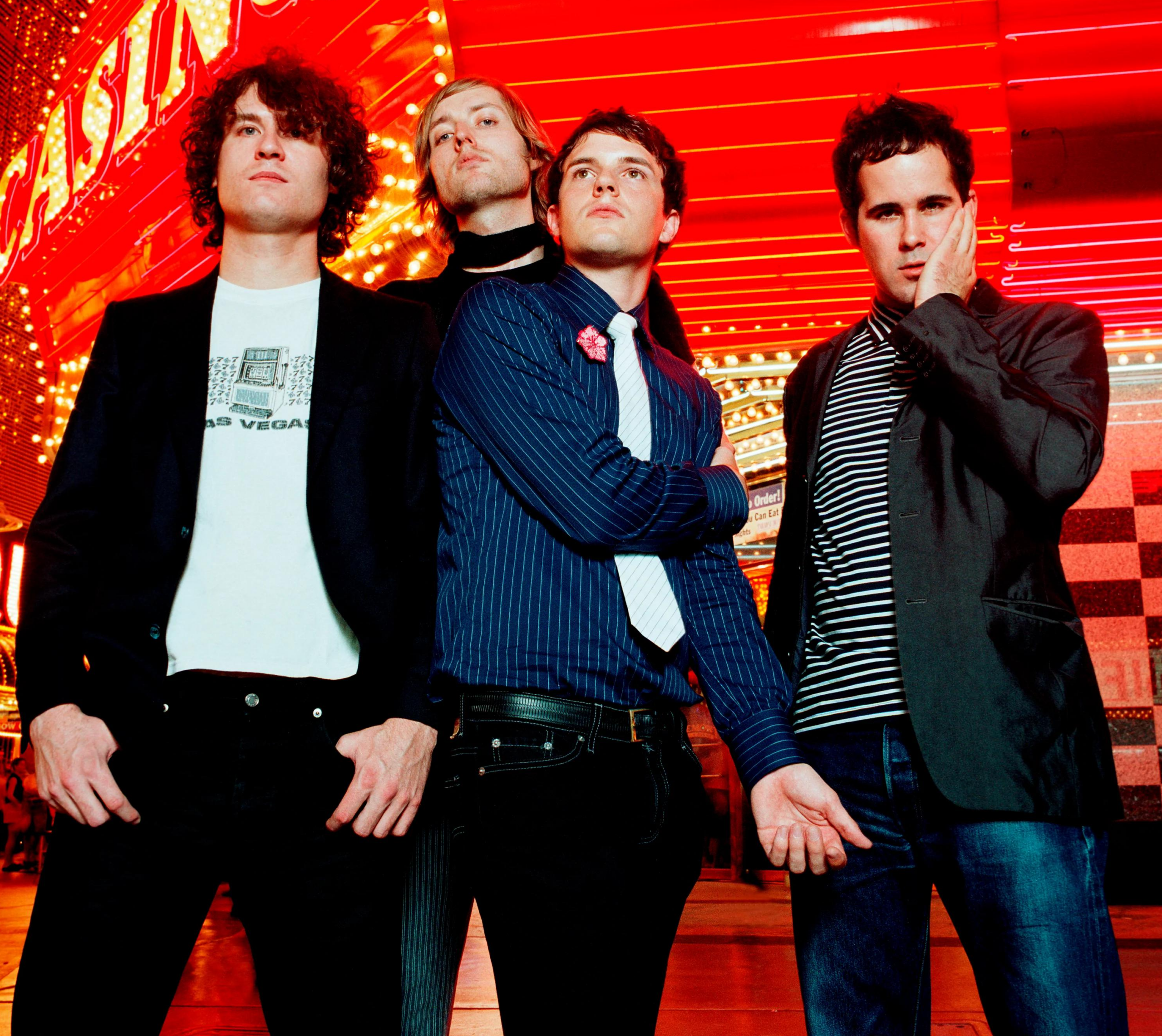
The Killers
On a small stage at Sasha’s, a transgender bar off the Las Vegas Strip on a one-way street nicknamed the Fruit Loop for all the LGBT-friendly venues, a young, four-man band in thrift-store shirts and skinny ties honed their version of their signature song, the bright, needling guitar line contrasting with a lyric about jealous obsession. Ironically, Brandon Flowers had recently met his wife-to-be at a thrift store while buying clothes for the band’s very first gig at a coffee shop called Cafe Espresso Roma, but “Mr. Brightside” was already there.
Flowers would later talk about how the convictions he gained from his faith and family helped him avoid the vices and pitfalls often associated with rock culture. Such confidence gave support to the hustle of playing rooms like Sasha’s where the Las Vegas temperatures would sometimes climb to 100° F and where Flowers and his bandmates were hoping for a break.
Flowers had been let go from his first band, Blush Response, when he refused to move with them to Los Angeles. Guitarist Dave Keuning had also been out of work, having been let go from the Banana Republic following the 9/11 tourism downturn. Keuning placed an ad in the Las Vegas Weekly: “Seeking musicians for all original band. Influences: Oasis, Smashing Pumpkins, Bowie, Radiohead.” Flowers, newly determined to front a band after seeing Oasis perform at the Hard Rock Hotel, answered. He and Keuning hit it off. The band name came from the music video for New Order’s “Crystal,” where a fictional band had a bass drum emblazoned with the name “The Killers.” Flowers and Keuning took the name as an homage.
The very first song on the first cassette Keuning shared was a riff Flowers vibed with. Keuning found the opening guitar figure while playing in a clothes-stuffed closet, the only place in his apartment he could turn his amp up without bringing the neighbors to the door. Flowers added lyrics about his emotional response to a faithless ex-partner and the resulting song became “Mr. Brightside.” But when the group’s first studio session arrived, Flowers hadn’t yet finished the song. He didn’t have a second verse so he simply repeated the first one – a single long sentence that packs in a full imagined narrative about what a shocked lover is certain must be happening behind closed doors – a short-circuit that mirrors the song’s portrayal of jealous obsession.
Their shows, at first, were not glamorous. Their earliest promoter, Ryan Pardey, ran a coffee shop called Cafe Espresso Roma and booked bands there on the side. Pardey gave Flowers and Keuning one of their first chances to perform under The Killers name. The unremarkable debut was a short set in front of people more interested in coffee and newspapers than in an unknown guitar band.
In late 2001 and early 2002, the band, initially a trio of Flowers, Keuning, and drummer Matt Norcross, soon joined by bassist Dell Neal, booked time at the Kill the Messenger Studio in Henderson. Across those first sessions they put down early versions of “Mr. Brightside,” “Desperate,” “Under the Gun” and “Replaceable,” burning CDRs to hand out at gigs. Norcross would not stay long, but that session fixed an early version of the band on tape and gave them something to pass around.
The band’s break came in the form of a young Warner Bros. talent scout, Braden Merrick. He found the band the way many people did in those years: clicking through a local-scene music website and expecting very little. Instead, he heard the Kill the Messenger version of “Mr. Brightside.” The tempo wobbled (Merrick actually mistook Norcross’s drumming for a bad drum machine) and the vocal wasn’t perfect, but he hear something promising. Merrick flew to Vegas, took the group to dinner, and eventually became their manager.