
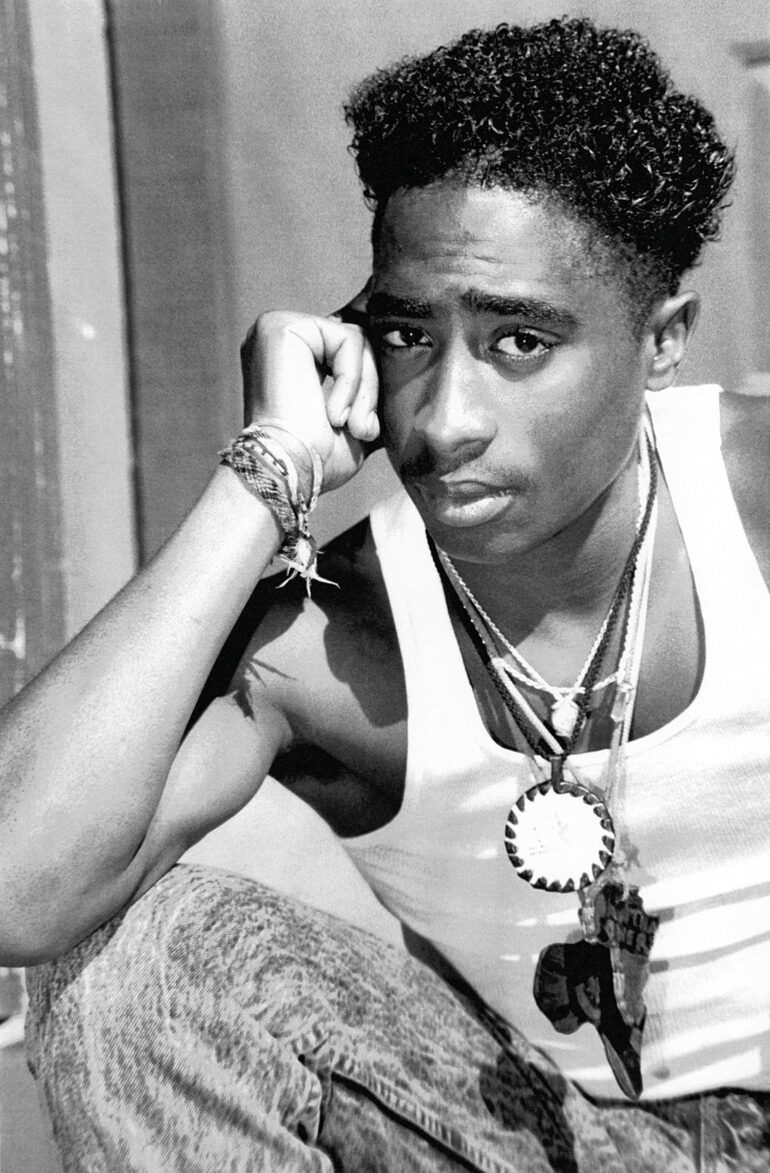
Tupac Shakur
The New York City neighborhood of Harlem in the late 1960s and 1970s, a majority-Black community staggering under decades of racist and economic segregationist policy, was a roiling mixture of poverty, unemployment, housing discrimination, drug abuse, activism, community organizing, and violence. Redlining and landlord neglect had hollowed out whole blocks while unemployment and a growing heroin trade frayed daily life. Meanwhile, Harlem remained a symbolic capital of Black political and cultural life, dense with churches, tenants’ groups, radical organizations, and artists who refused to accept the neighborhood’s decline as inevitable. This was the New York Stevie Wonder sang “Living for the City” about, the New York Bill Withers wrote “Harlem” about, the New York imagined in Marvin Gaye’s “Inner City Blues (Make Me Wanna Holler).”
The Black Panther Party found fertile ground in this mix of crisis and resistance. Twenty-one-year-old Afeni Shakur joined the Panthers’ Harlem branch in 1968 and quickly emerged as an organizer and section leader, helping recruit members, run free-breakfast programs, and organize rent strikes against landlords who refused to maintain their buildings. In April 1969, Afeni and 20 other Harlem Panthers were arrested and charged with a broad conspiracy to bomb department stores, police stations, and other targets. Over the next two years she represented herself in court, studied case law in the jail’s law library before she was able to post bail, and cross-examined witnesses. In May 1971, after an eight-month trial, the jury spent less than 2 hours in deliberation to acquit all remaining defendants of 156 counts. A month later, Afeni gave birth to her son, Lesane Parish Crooks, but within his first year she renamed him Tupac Amaru Shakur, after Tupac Amaru II, the 18th-century Peruvian revolutionary, a name meant to carry a history of resistance.
The Shakur name itself placed the child inside a wider political constellation. His stepfather, Dr. Mutulu Shakur, was a Black liberation activist later convicted of involvement in a 1981 Brink’s robbery; his godfather, Geronimo Ji-Jaga Pratt, was a former Los Angeles Panther who would later be framed for murder by the FBI and exonerated 25 years later, and his godmother, Assata Shakur, lived in exile in Cuba after escaping prison on a New Jersey State Trooper murder charge. Through the 1970s and early 1980s the family pinballed between Harlem and the Bronx, then, as Afeni tried to outrun both political surveillance and personal struggles, south to Baltimore and eventually west to Marin City, California. Cheap apartments, relatives’ couches, stretches in homeless shelters when money or patience ran out were a constant.
Yet from the beginning Tupac’s life was also threaded with art. In New York, Afeni took him to political meetings and cultural events. He would later say that he grew up listening to people argue about liberation strategy in the living room. In his early adolescence, even as Afeni slipped into crack addiction and the family spent time in homeless shelters, he managed to land a place with the 127th Street Repertory Ensemble, a Harlem theater company. Around age twelve he made his stage debut as Travis Younger in A Raisin in the Sun at Harlem’s Apollo Theater.
Another move brought him to Baltimore. There, he was accepted into the Baltimore School for the Arts, where he studied acting, poetry, jazz, and ballet. Teachers later remembered him as a serious, driven student: he performed Shakespeare, danced as the Mouse King in The Nutcracker, and spent hours debating politics and aesthetics with classmates like Jada Pinkett. In this period he performed under the name MC New York, a persona that captured both his origins and his aspirations to compete in East Coast–style rap battles.
Baltimore also sharpened his political sensibility. Under the guidance of a politically engaged teacher, Mary Baldridge, Tupac read Malcolm X, studied radical history, and began to see his own family’s struggles as part of a larger pattern. He won an anti-violence award for Us Killing Us Equals Genocide, a rap that indicted both the state and the self-destruction of street life. He later won a rap contest at age 14 as part of a public-service project to draw kids into the local library.
Then, another uprooting: Afeni moved the family west, ending up in Marin City, a mostly Black housing project community wedged into the wealthy Marin County landscape north of San Francisco. Tupac enrolled at Tamalpais High School, joined the Ensemble Theatre Company, and continued acting even as he felt increasingly out of place. In the Bay Area he began to push more seriously into rap. In 1988, after moving in with a neighbor and briefly selling drugs to get by, he fell in with local MC Ray Luv and DJ Dize; together they formed the group Strictly Dope, cutting rough demos on cheap home equipment and performing at small shows around Marin City and Oakland.
Around the same time, Tupac began attending a poetry and performance workshop in Oakland run out of the living room of Leila Steinberg, an educator and promoter who invited local teenagers to read poets and philosophers and then write their own work in response.
Steinberg saw something in the 17-year-old Tupac that she had been looking for: A voice “who read like crazy and could tackle issues that we don’t talk about,” she told interviewer Allison Kugel.
“Public Enemy was too radical,” Steinberg said. “There were artists that were in hip hop that were using their voices, but they couldn’t penetrate the schools, because they were too extreme. I was looking for somebody that could straddle these worlds … and from the first poem, I knew.”
She and her husband opened their home to Tupac and Ray Luv when Afeni’s addiction or finances made housing unstable. By 1989 she had formally become his manager, coaching him on how to navigate interviews, contracts, and his own ambition. Through Bay Area connections she introduced Tupac and Strictly Dope to Atron Gregory, the manager of Digital Underground, then riding high off the success of their platinum-selling hit The Humpty Dance. Gregory heard the demos and invited Tupac on the road first as a roadie and general helper, then as a backup dancer and on-stage hype man. Tupac lugged bags, learned tour discipline, and grabbed short verses where he could.
The formal introduction came with “Same Song.” Recorded in 1990 and released in early 1991 on the Nothing but Trouble soundtrack and Digital Underground’s This Is an EP Release, the track gave Tupac his first national verse and his first appearance in a major-label video. Shock G sets him up and a young Tupac explodes into his 16 bars, compacting travelogue, braggadocio, and flashes of political imagery.
By then, the path to a solo deal was already opening. Gregory and the Digital Underground camp (working under the production name Underground Railroad) began building out solo material, using Tupac’s Strictly Dope-era political pieces as a template for something harder and more focused. Steinberg stayed on as co-manager, advocating for the larger vision of what his career could mean beyond club hits, even as Gregory handled the industry side.
In 1991, as West Coast “gangsta rap” and socially conscious records from groups like N.W.A. and Public Enemy were drawing national attention, Gregory shopped Tupac’s demos to labels. Interscope, then a relatively young company looking for artists with edge and crossover potential, offered a deal routed through TNT Recordings, with production handled by Underground Railroad. Recording sessions for what would become 2Pacalypse Now began at Starlight Sound in the Bay Area in the spring and summer of 1991.
The 19-year-old Tupac, the artistic virtuoso who had spent years on the verge of homelessness, the teen who saw himself in Don McLean’s ballad of Vincent van Gogh, was about to cut an album of such political and social depth that would shape the history of music, garner the ire of national political figures like Vice President Dan Quayle, and launch his career as one of the greatest rappers to ever live.
By Sean Ransom – December 27, 2025